The World
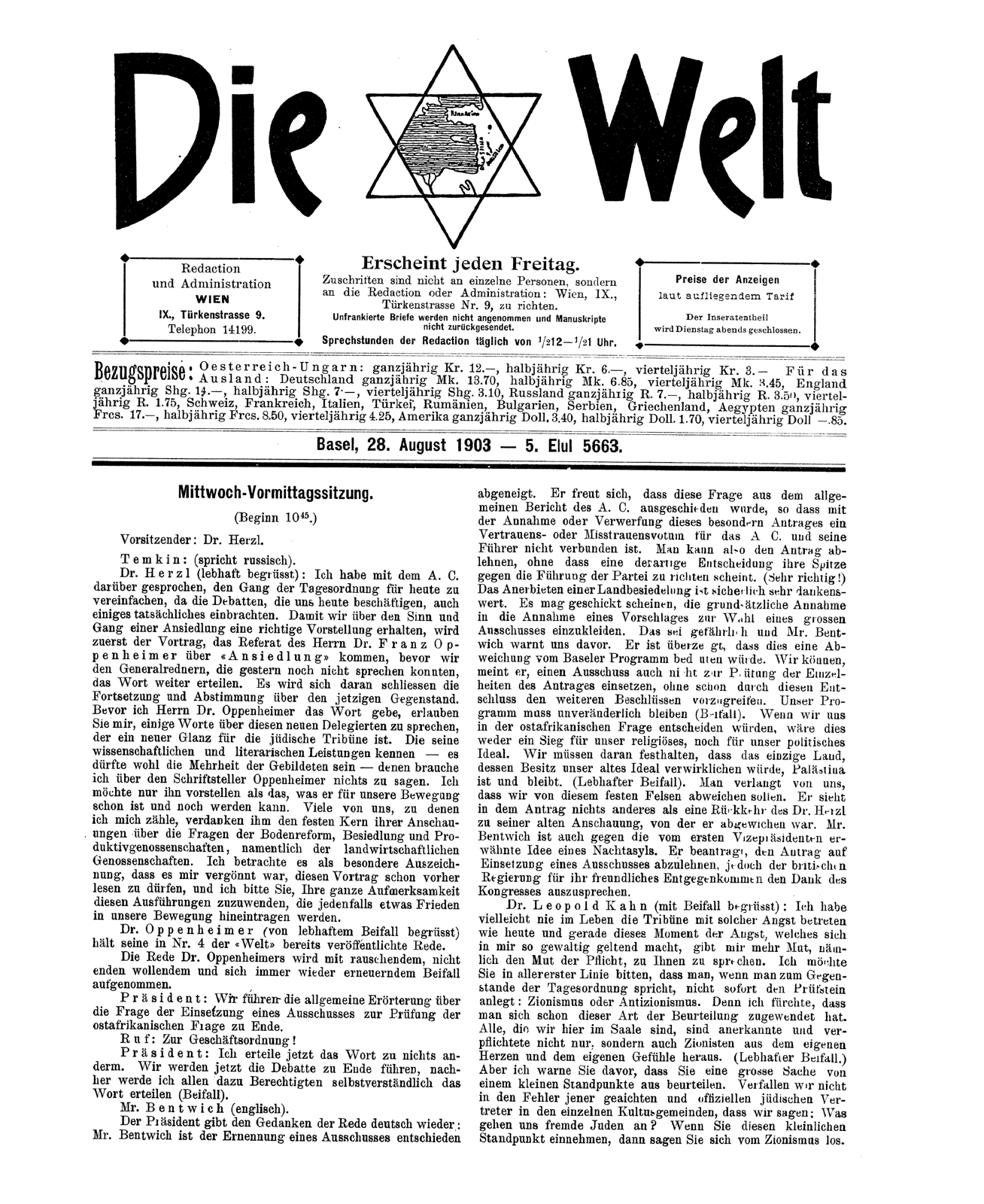
Die Welt
Editorial Office and Administration: VIENNA, IX., Türkenstrasse 9. Telephone 14199.
Appears every Friday. Correspondence is to be addressed not to individual persons but to the Editorial Office or Administration: Vienna, IX., Türkenstrasse No. 9. Unstamped letters are not accepted, and manuscripts are not returned. Editorial office hours daily from half-past eleven to half-past twelve.
Advertising rates as per the published tariff. The advertisement section closes on Tuesday evening.
Subscription rates: Austria-Hungary: yearly Kr. 12.—, half-yearly Kr. 6.—, quarterly Kr. 3.—. Abroad: Germany yearly Mk. 13.70, half-yearly Mk. 6.85, quarterly Mk. 3.45; England yearly Shg. 14.—, half-yearly Shg. 7.—, quarterly Shg. 3.10; Russia yearly R. 7.—, half-yearly R. 3.50, quarterly R. 1.75; Switzerland, France, Italy, Turkey, Roumania, Bulgaria, Servia, Greece, Egypt yearly Frcs. 17.—, half-yearly Frcs. 8.50, quarterly 4.25; America yearly Doll. 3.40, half-yearly Doll. 1.70, quarterly Doll —.85.
Basle, 28 August 1903 — 5 Elul 5663.
Wednesday Morning Session.
(Opened at 10.45.)
Chairman: Dr. Herzl.
Temkin: (speaks in Russian).
Dr. Herzl (warmly greeted): I have discussed with the A. C. how to simplify the course of to-day's order of business, since the debates which occupy us to-day have also brought forward a number of matters of fact. In order that we may obtain a correct idea of the meaning and course of a settlement, the address, the report of Dr. Franz Oppenheimer on "Settlement," will come first, before we continue to give the floor to the general speakers who were not yet able to speak yesterday. There will follow the continuation of, and the vote upon, the present subject. Before I give the floor to Dr. Oppenheimer, allow me to say a few words about this new delegate, who is a new lustre to the Jewish tribune. To those who know his scientific and literary achievements — and that may well be the majority of the educated — I need say nothing about Oppenheimer the writer. I should like only to present him as that which he already is, and may yet become, for our movement. Many of us, among whom I count myself, owe to him the firm core of their views on the questions of land reform, settlement and productive co-operatives, in particular agricultural co-operatives. I regard it as a special distinction that I was privileged to read this address beforehand, and I beg you to turn your whole attention to these remarks, which will at all events carry some peace into our movement.
Dr. Oppenheimer (greeted with lively applause) delivers his address, already published in No. 4 of "Die Welt."
Dr. Oppenheimer's address is received with tumultuous, unending and ever-renewed applause.
President: We shall bring to a close the general discussion on the question of appointing a committee to examine the East African question.
A voice: On a point of order!
President: I give the floor now for nothing else. We shall now bring the debate to a close; afterwards I shall of course give the floor to all who are entitled to it (Applause).
Mr. Bentwich (in English).
The President renders the substance of the speech in German: Mr. Bentwich is decidedly averse to the appointment of a committee. He is glad that this question has been separated from the general report of the A. C., so that no vote of confidence or of no confidence in the A. C. and its leaders is bound up with the acceptance or rejection of this particular motion. One may therefore reject the motion without such a decision appearing to be aimed against the leadership of the party. (Quite right!) The offer of a settlement of land is certainly most deserving of thanks. It may seem clever to clothe acceptance in principle in the acceptance of a proposal to elect a large committee. That, he says, is dangerous, and Mr. Bentwich warns us against it. He is convinced that this would signify a departure from the Basle Programme. Nor, he thinks, can we appoint a committee even to examine the details of the proposal without anticipating further resolutions by that very decision. Our programme must remain unalterable (Applause). If we were to decide in favour of the East African question, it would be a victory neither for our religious nor for our political ideal. We must hold fast to this: that the only land whose possession would realise our ancient ideal is and remains Palestine. (Lively applause.) We are asked to depart from this firm rock. He sees in the motion nothing other than a return of Dr. Herzl to his old view, from which he had departed. Mr. Bentwich is also opposed to the idea of a night-shelter mentioned by the First Vice-President. He moves that the motion to appoint a committee be rejected, but that the thanks of the Congress be expressed to the British Government for its friendly overture.
Dr. Leopold Kahn (greeted with applause): Perhaps never in my life have I mounted the tribune with such anxiety as to-day, and it is precisely this moment of anxiety, which asserts itself in me so mightily, that gives me more courage — namely, the courage of duty — to speak to you. I should like first and foremost to beg of you that, when one speaks to the subject on the order of the day, one should not at once apply the touchstone: Zionism or anti-Zionism. For I fear that people have already turned to this manner of judging. All of us who are here in this hall are not only acknowledged and pledged Zionists, but Zionists from our own hearts and our own feeling. (Lively applause.) But I warn you against judging a great cause from a small standpoint. Let us not fall into the error of those certified and official Jewish representatives in the several congregations, and say: What have foreign Jews to do with us? If you take up this petty standpoint, then you renounce Zionism.