The World
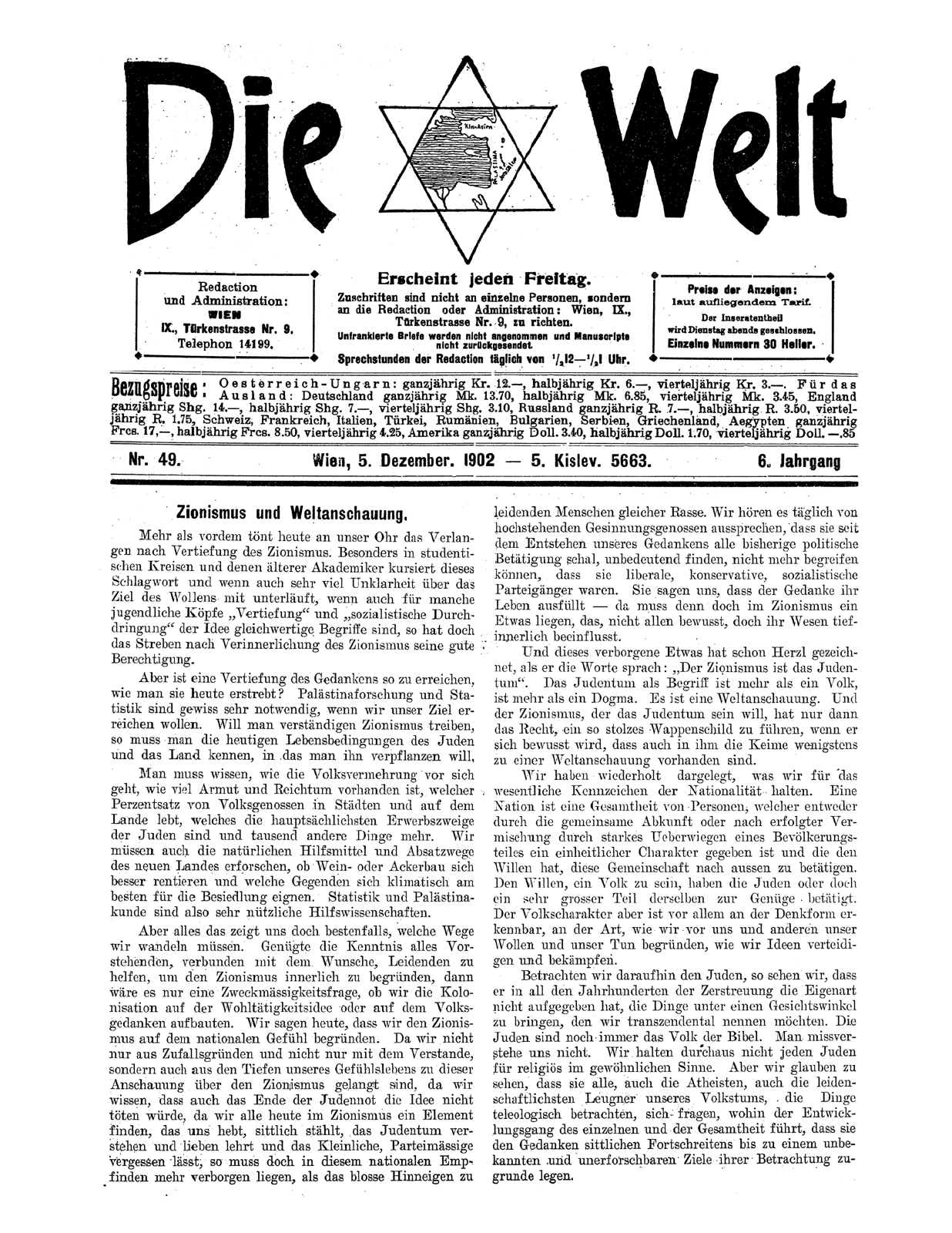
Die Welt
Published every Friday.
Editorial and business offices: VIENNA IX., Türkenstrasse No. 9, telephone 14199. Correspondence is to be addressed not to individual persons but to the Editor or the Administration, Vienna, IX., Türkenstrasse No. 9. Unstamped letters are not accepted and manuscripts are not returned. The editorial office receives callers daily from ½12 to ½1 o'clock. Advertisement rates: according to the tariff on file; the advertising section closes on Tuesday evening. Single numbers 30 Heller.
Subscription rates: Austria-Hungary: yearly Kr. 12.—, half-yearly Kr. 6.—, quarterly Kr. 3.—. Abroad: Germany yearly Mk. 13.70, half-yearly Mk. 6.85, quarterly Mk. 3.45; England yearly Shg. 14.—, half-yearly Shg. 7.—, quarterly Shg. 3.10; Russia yearly R. 7.—, half-yearly R. 3.50, quarterly R. 1.75; Switzerland, France, Italy, Turkey, Roumania, Bulgaria, Servia, Greece, Egypt yearly Frcs. 17.—, half-yearly Frcs. 8.50, quarterly 4.25; America yearly Doll. 3.40, half-yearly Doll. 1.70, quarterly Doll. —.85
No. 49. — Vienna, 5 December 1902 — 5 Kislev 5663. — 6th Year
Zionism and a View of the World.
More than ever before, the demand for a deepening of Zionism falls upon our ear to-day. The watchword circulates above all in student circles and among older university men, and although a great deal of obscurity as to the aim of this desire creeps in, and although for many youthful heads the "deepening" and the "socialist permeation" of the idea are equivalent notions, the striving after a more inward Zionism is nevertheless well justified.
But can a deepening of the idea be attained in the manner in which it is sought to-day? Research into Palestine and statistics are certainly very necessary if we mean to reach our goal. Whoever would pursue an intelligent Zionism must know the present conditions of the Jew's life and the land into which one wishes to transplant him.
One must know how the population increases, how much poverty and wealth there is, what percentage of our people live in the towns and what in the country, which are the chief occupations of the Jews, and a thousand other things besides. We must also investigate the natural resources and the markets of the new land, whether vine-growing or tillage will pay the better, and which districts are best suited by climate for settlement. Statistics and the knowledge of Palestine are thus very useful auxiliary sciences.
But all this shows us at best only which paths we must tread. If the knowledge of all the foregoing, joined with the wish to help the suffering, sufficed to give Zionism its inner foundation, then it would be merely a question of expediency whether we built colonisation upon the idea of charity or upon the national idea. We say to-day that we found Zionism upon national feeling. Since we have arrived at this view of Zionism not merely from accidental causes and not merely by the understanding, but also out of the depths of our emotional life; since we know that even the end of Jewish distress would not kill the idea; since all of us to-day find in Zionism an element that raises us, steels us morally, teaches us to understand and to love Judaism, and makes us forget what is petty and partisan — then surely there must lie hidden in this national sentiment something more than the mere inclination towards suffering men of the same race. We hear it said daily by like-minded men of high standing that since our idea came into being they find all their former political activity stale and insignificant, and can no longer understand how they were ever partisans of the Liberals, the Conservatives, the Socialists. They tell us that the idea fills their lives — and so there must surely lie in Zionism a Something which, though not all are conscious of it, yet profoundly and inwardly influences their being.
And this hidden Something Herzl already sketched when he spoke the words: "Zionism is Judaism." Judaism as a concept is more than a people, more than a dogma. It is a view of the world. And Zionism, which would be Judaism, has the right to bear so proud an escutcheon only when it becomes conscious that in it, too, lie the germs at least of a view of the world.
We have repeatedly set forth what we hold to be the essential mark of nationality. A nation is a body of persons to whom a uniform character has been given, either by common descent or, after an intermingling has taken place, by the strong preponderance of one part of the population, and which has the will to assert this community outwardly. The will to be a people the Jews, or at any rate a very large part of them, have sufficiently shown. But the character of a people is recognisable above all by its form of thought, by the manner in which we justify our willing and our doing before ourselves and others, and in which we defend and combat ideas.
If we regard the Jew from this point of view, we see that in all the centuries of the Dispersion he has not given up the peculiarity of bringing things under an angle of vision which we should like to call transcendental. The Jews are still the people of the Bible. Let us not be misunderstood. We by no means consider every Jew religious in the ordinary sense. But we believe we can see that all of them, the atheists too, even the most passionate deniers of our nationhood, regard things teleologically, ask themselves whither the course of development of the individual and of the whole is leading, and make the idea of moral progress towards an unknown and unsearchable goal the foundation of their reflection.