The World
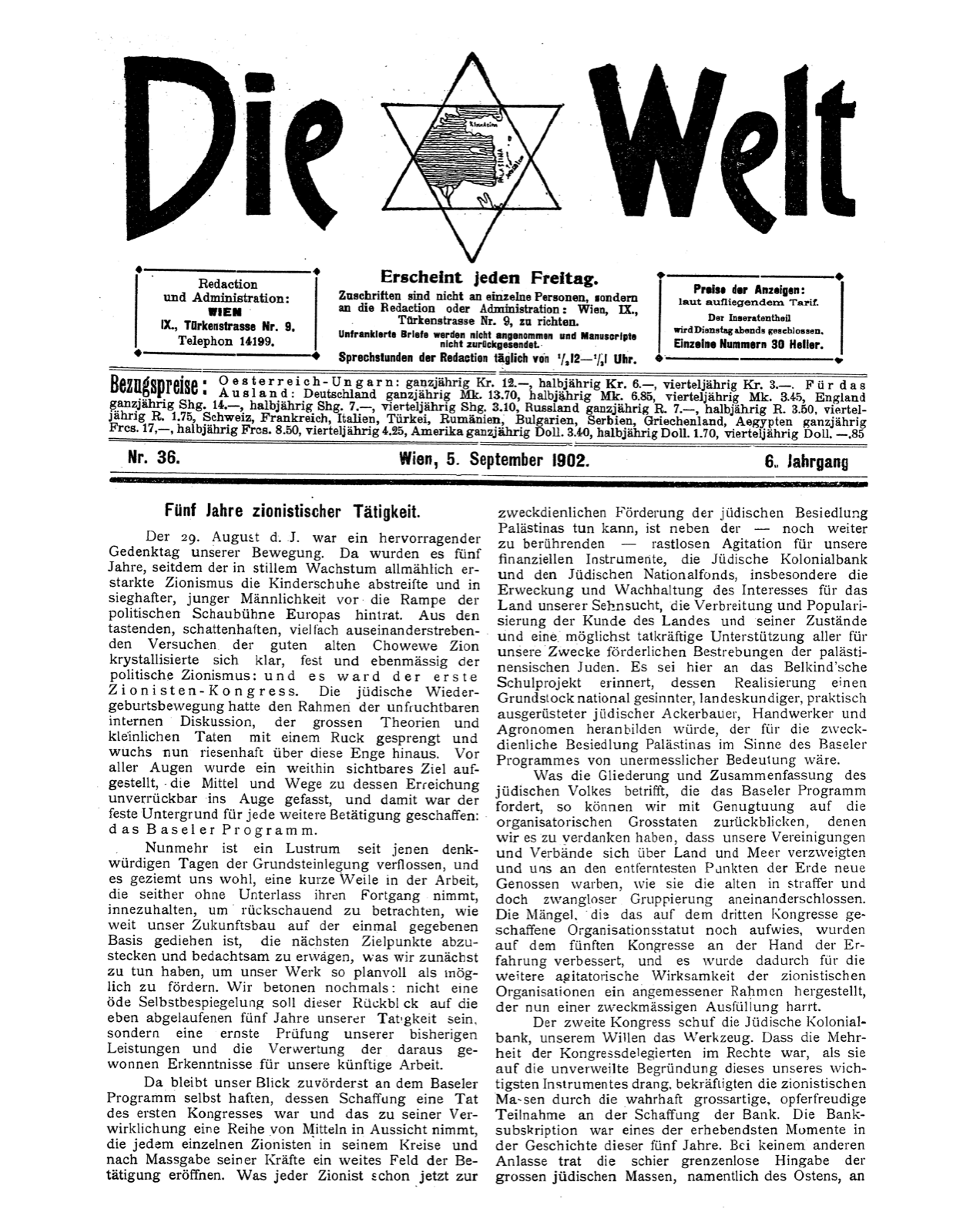
Die Welt
Editorial Office and Administration: VIENNA, IX., Türkenstrasse No. 9. Telephone 14199.
Appears every Friday. Correspondence is to be addressed not to individual persons but to the Editorial Office or the Administration: Vienna, IX., Türkenstrasse No. 9. Unstamped letters are not accepted, and manuscripts are not returned. Editorial office hours daily from ½12 to ½1 o'clock.
Advertisement rates: according to the tariff available on request. The advertising section closes on Tuesday evening. Single numbers 30 Heller.
Subscription prices: Austria-Hungary: yearly Kr. 12.—, half-yearly Kr. 6.—, quarterly Kr. 3.—. Abroad: Germany yearly Mk. 13.70, half-yearly Mk. 6.85, quarterly Mk. 3.45; England yearly Shg. 14.—, half-yearly Shg. 7.—, quarterly Shg. 3.10; Russia yearly R. 7.—, half-yearly R. 3.50, quarterly R. 1.75; Switzerland, France, Italy, Turkey, Roumania, Bulgaria, Servia, Greece, Egypt yearly Frcs. 17.—, half-yearly Frcs. 8.50, quarterly 4.25; America yearly Doll. 3.40, half-yearly Doll. 1.70, quarterly Doll. —.85
No. 36. | Vienna, 5 September 1902. | 6th Year
Five Years of Zionist Activity.
The 29th of August of this year was a signal day of remembrance for our movement. On that day five years had passed since Zionism, grown gradually strong in quiet growth, cast off its children's shoes and stepped forth, in victorious young manhood, before the footlights of Europe's political stage. Out of the groping, shadowy, and often divergent efforts of the good old Chovevei Zion there crystallized, clear, firm and well-proportioned, political Zionism: and there came into being the first Zionist Congress. The movement for Jewish rebirth had at one stroke burst the frame of barren internal discussion, of great theories and petty deeds, and now grew to giant stature far beyond those narrow bounds. Before the eyes of all a goal visible from afar was set up, the means and ways of attaining it were steadfastly fixed upon, and thereby the firm foundation was laid for every further activity: the Basle Programme.
A lustrum has now elapsed since those memorable days when the foundation-stone was laid, and it well becomes us to pause for a short while in the work, which has gone forward without cease ever since, in order to consider in retrospect how far our edifice of the future has advanced upon the basis once given, to mark out the next objectives, and to weigh deliberately what we have first to do in order to further our work as systematically as possible. We emphasize once more: this retrospect of the five years of our activity just concluded is not to be a dreary self-contemplation, but an earnest examination of our achievements hitherto, and the turning to account of the knowledge thus gained for our future labours.
Here our gaze rests first upon the Basle Programme itself, the creation of which was a deed of the first Congress, and which contemplates for its realization a series of means that open a wide field of activity to every individual Zionist in his own circle and according to the measure of his powers. What every Zionist can do even now for the effective furtherance of the Jewish settlement of Palestine is — besides the untiring agitation, to be touched upon further below, on behalf of our financial instruments, the Jewish Colonial Bank and the Jewish National Fund — in particular the awakening and sustaining of interest in the land of our longing, the spreading and popularizing of knowledge of the land and its conditions, and the most vigorous possible support of all endeavours of the Palestinian Jews that serve our ends. Let us recall here the Belkind school project, the realization of which would train a nucleus of nationally minded, locally informed, practically equipped Jewish husbandmen, artisans and agronomists, who would be of immeasurable importance for the effective settlement of Palestine in the sense of the Basle Programme.
As regards the organization and uniting of the Jewish people which the Basle Programme demands, we may look back with satisfaction upon the great organizing achievements to which we owe it that our societies and federations have branched out over land and sea, winning us new comrades at the remotest points of the earth, even as they bound the old ones together in a firm yet unconstrained grouping. The defects which the Organization Statute created at the third Congress still exhibited were amended at the fifth Congress in the light of experience, and a suitable framework was thereby provided for the further agitational work of the Zionist organizations, which now awaits being filled out to good purpose.
The second Congress created the Jewish Colonial Bank, the instrument of our will. That the majority of the Congress delegates were in the right when they pressed for the immediate founding of this, our most important instrument, was confirmed by the Zionist masses through their truly magnificent and self-sacrificing participation in the creation of the Bank. The Bank subscription was one of the most uplifting moments in the history of these five years. On no other occasion did the well-nigh boundless devotion of the great Jewish masses, especially those of the East, to