The World
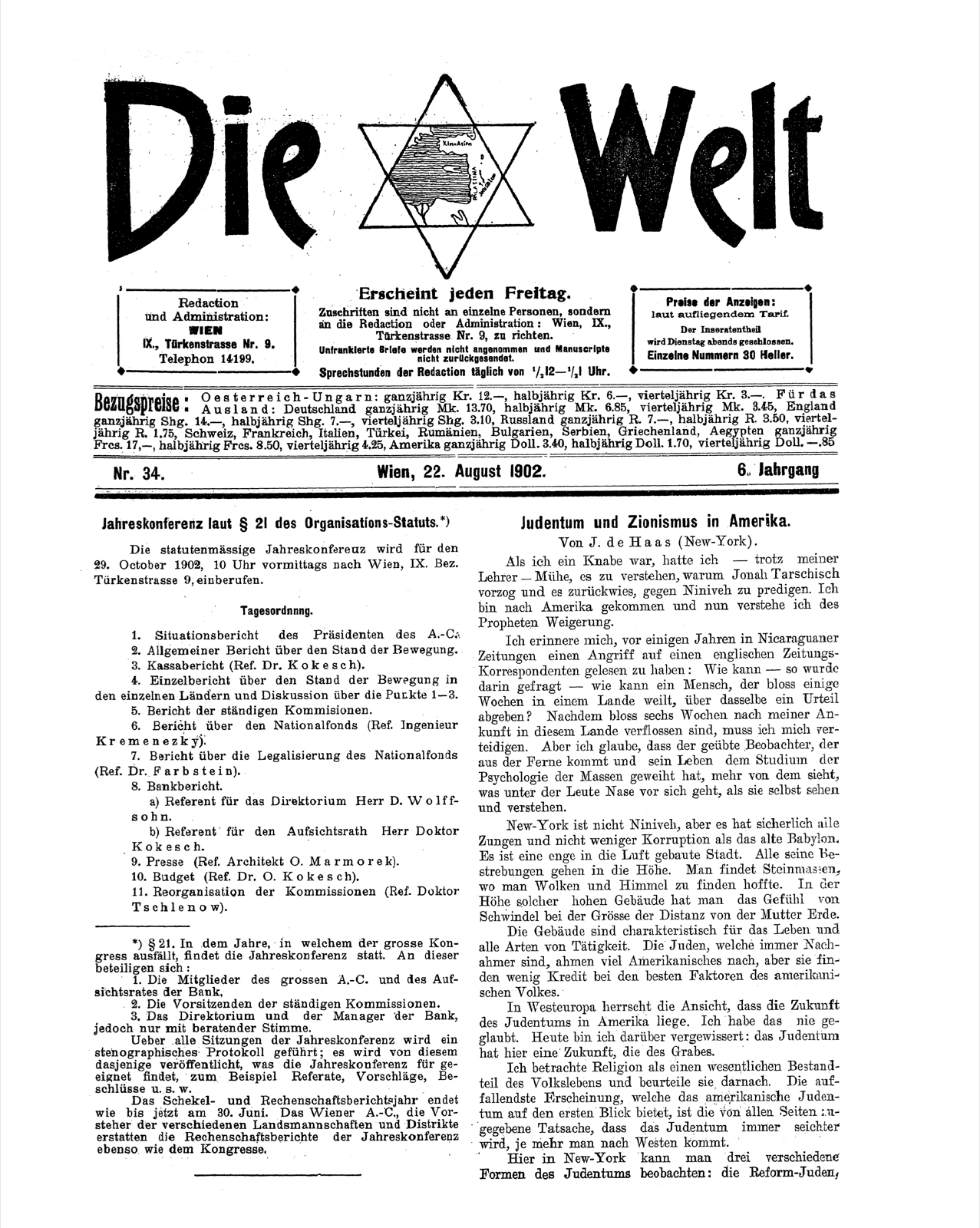
Die Welt
Published every Friday.
Editorial Office and Administration: Vienna IX., Türkenstrasse No. 9. Telephone 14199. Communications are to be addressed not to individual persons but to the Editorial Office or the Administration: Vienna, IX., Türkenstrasse No. 9. Unstamped letters are not accepted, and manuscripts are not returned. The editors receive daily from half past eleven to half past twelve. Advertising rates: according to the tariff available on request. The advertisement section closes on Tuesday evening. Single numbers 30 Heller.
Subscription rates: Austria-Hungary: yearly Kr. 12.—, half-yearly Kr. 6.—, quarterly Kr. 3.—. Abroad: Germany yearly Mk. 13.70, half-yearly Mk. 6.85, quarterly Mk. 3.45; England yearly Shg. 14.—, half-yearly Shg. 7.—, quarterly Shg. 3.10; Russia yearly R. 7.—, half-yearly R. 3.50, quarterly R. 1.75; Switzerland, France, Italy, Turkey, Roumania, Bulgaria, Servia, Greece, Egypt yearly Frcs. 17.—, half-yearly Frcs. 8.50, quarterly Frcs. 4.25; America yearly Doll. 3.40, half-yearly Doll. 1.70, quarterly Doll. —.85
No. 34. | Vienna, 22 August 1902. | 6th Year
Annual Conference in accordance with § 21 of the Statutes of Organisation.*)
The statutory Annual Conference is hereby convened for 29 October 1902, at 10 o'clock in the forenoon, in Vienna, IX. District, Türkenstrasse 9.
Order of the Day.
- Report of the President of the A.-C. on the situation.
- General report on the state of the movement.
- Treasurer's report (Reporter Dr. Kokesch).
- Detailed report on the state of the movement in the several countries, and discussion of items 1–3.
- Report of the standing commissions.
- Report on the National Fund (Reporter Engineer Kremenezky).
- Report on the legalisation of the National Fund (Reporter Dr. Farbstein).
- Bank report. a) Reporter for the Board of Directors, Mr. D. Wolffsohn. b) Reporter for the Supervisory Council, Dr. Kokesch.
- Press (Reporter Architect O. Marmorek).
- Budget (Reporter Dr. O. Kokesch).
- Reorganisation of the commissions (Reporter Dr. Tschlenow).
*) § 21. In the year in which the great Congress does not take place, the Annual Conference is held. There take part in it:
- The members of the Greater A.-C. and of the Supervisory Council of the Bank,
- The chairmen of the standing commissions,
- The Board of Directors and the Manager of the Bank, but with an advisory voice only.
A stenographic record is kept of all sittings of the Annual Conference; of this, such portions are published as the Annual Conference deems suitable, for example reports, proposals, resolutions, etc.
The Shekel and financial-report year ends, as hitherto, on 30 June. The Vienna A.-C. and the heads of the various Federations and Districts render their financial reports to the Annual Conference just as to the Congress.
Judaism and Zionism in America. By J. de Haas (New York).
When I was a boy I found it hard — in spite of my teachers — to understand why Jonah preferred Tarshish and refused to preach against Nineveh. I have come to America, and now I understand the prophet's refusal.
I remember reading, some years ago, in Nicaraguan newspapers an attack upon an English newspaper correspondent: How can — so it was asked — how can a man who has stayed but a few weeks in a country pass judgment upon it? As only six weeks have passed since my arrival in this country, I must defend myself. But I believe that the practised observer who comes from afar, and who has devoted his life to the study of the psychology of the masses, sees more of what goes on under people's noses than they themselves see and understand.
New York is not Nineveh, but it certainly has all tongues and no less corruption than ancient Babylon. It is a narrow city, built into the air. All its aspirations go upward. One finds masses of stone where one had hoped to find clouds and sky. At the top of such lofty buildings one has a feeling of giddiness at the greatness of the distance from Mother Earth.
The buildings are characteristic of the life and of every kind of activity. The Jews, who are always imitators, imitate much that is American, but they find little credit with the best elements of the American people.
In Western Europe the view prevails that the future of Judaism lies in America. I never believed it. To-day I am assured of it: Judaism has a future here — that of the grave.
I regard religion as an essential element of a people's life and judge it accordingly. The most striking phenomenon which American Judaism presents at first glance is the fact, admitted on all sides, that Judaism grows ever shallower the farther west one goes.
Here in New York one may observe three different forms of Judaism: the Reform Jews,