The World
Die Welt
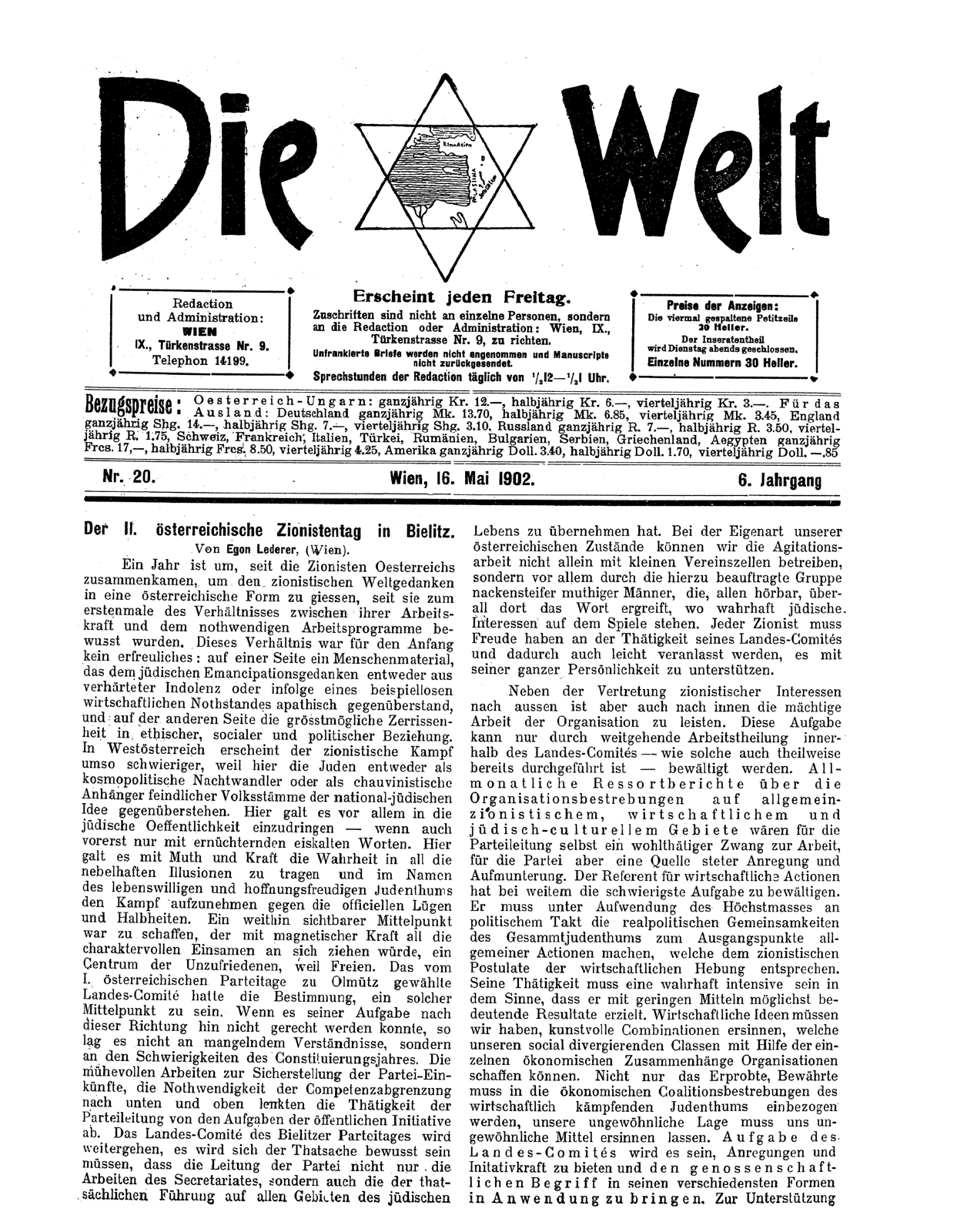
[Logo: A six-pointed star with a map of the world at its centre and the inscriptions "Kinaatira" and "Palästina Jerusalem"]
Editorial Office and Administration: VIENNA, IX., Türkenstrasse No. 9. Telephone 14199.
Appears every Friday. Communications are to be addressed not to individual persons but to the Editorial Office or the Administration: Vienna, IX., Türkenstrasse No. 9. Unstamped letters are not accepted, and manuscripts are not returned. The editors' consulting hours are daily from half-past eleven to half-past twelve.
Advertising rates: the four-column petit line, 20 Heller. The advertisement section closes on Tuesday evening. Single numbers, 30 Heller.
Subscription rates: Austria-Hungary: yearly Kr. 12.—, half-yearly Kr. 6.—, quarterly Kr. 3.—. Abroad: Germany yearly Mk. 13.70, half-yearly Mk. 6.85, quarterly Mk. 3.45; England yearly Shg. 14.—, half-yearly Shg. 7.—, quarterly Shg. 3.10; Russia yearly R. 7.—, half-yearly R. 3.50, quarterly R. 1.75; Switzerland, France, Italy, Turkey, Roumania, Bulgaria, Servia, Greece, Egypt yearly Frcs. 17.—, half-yearly Frcs. 8.50, quarterly 4.25; America yearly Doll. 3.40, half-yearly Doll. 1.70, quarterly Doll. —.85
No. 20. | Vienna, 16 May 1902. | 6th Year
The Second Austrian Zionist Conference at Bielitz.
By Egon Lederer, (Vienna).
A year has passed since the Zionists of Austria came together to cast the Zionist world-idea into an Austrian form, since they became conscious for the first time of the relation between their working strength and the necessary programme of work. At the outset this relation was not a gratifying one: on the one side a human material which stood apathetic towards the idea of Jewish emancipation, either out of hardened indolence or in consequence of an unexampled economic distress, and on the other side the greatest possible disunion in ethical, social, and political respects. In Western Austria the Zionist struggle appears all the more difficult because here the Jews confront the national-Jewish idea either as cosmopolitan sleep-walkers or as chauvinistic adherents of hostile races. Here it was needful above all to penetrate into Jewish public life — even if at first only with sobering, ice-cold words. Here it was needful to carry the truth, with courage and strength, into all the misty illusions, and, in the name of a Judaism willing to live and joyful in hope, to take up the fight against the official lies and half-measures. A centre visible far and wide had to be created, which would draw to itself with magnetic force all the solitary men of character — a centre of the discontented, because free. The Provincial Committee elected by the First Austrian Party Conference at Olmütz was destined to be such a centre. If it could not do justice to its task in this direction, the cause lay not in want of understanding but in the difficulties of the year of its constitution. The laborious work of securing the Party's revenues, and the necessity of delimiting its competence below and above, diverted the activity of the Party leadership from the tasks of public initiative. The Provincial Committee of the Bielitz Conference will go further; it will have to be conscious of the fact that the leadership of the Party must undertake not only the labours of the secretariat but also those of actual leadership in every field of Jewish life. Given the peculiar character of our Austrian conditions, we cannot carry on the work of agitation with small society-cells alone, but above all through a group of stiff-necked, courageous men charged with this purpose, who, audible to all, take the word wherever truly Jewish interests are at stake. Every Zionist must take joy in the activity of his Provincial Committee, and thereby be readily moved to support it with his whole personality.
Besides the representation of Zionist interests outwardly, however, the mighty work of organisation must also be performed inwardly. This task can be mastered only through a far-reaching division of labour within the Provincial Committee — such as has in part already been carried out. Monthly departmental reports on the organising endeavours in the general-Zionist, economic, and Jewish-cultural fields would be for the Party leadership itself a salutary compulsion to work, and for the Party a source of constant stimulus and encouragement. The reporter for economic actions has by far the most difficult task to master. With the utmost expenditure of political tact he must make the practical-political interests common to all Jewry the starting-point of general actions which answer to the Zionist postulate of economic elevation. His activity must be a truly intensive one, in the sense that with slender means he attains the most considerable results possible. We must have economic ideas, must devise ingenious combinations which, by the help of the individual economic connections, can create organisations for our socially divergent classes. Not only what has been tried and proved must be drawn into the economic efforts at coalition of a Jewry struggling for its livelihood; our unusual situation must lead us to devise unusual means. It will be the task of the Provincial Committee to furnish suggestions and power of initiative, and to bring the co-operative idea into application in its most various forms. To support