The World
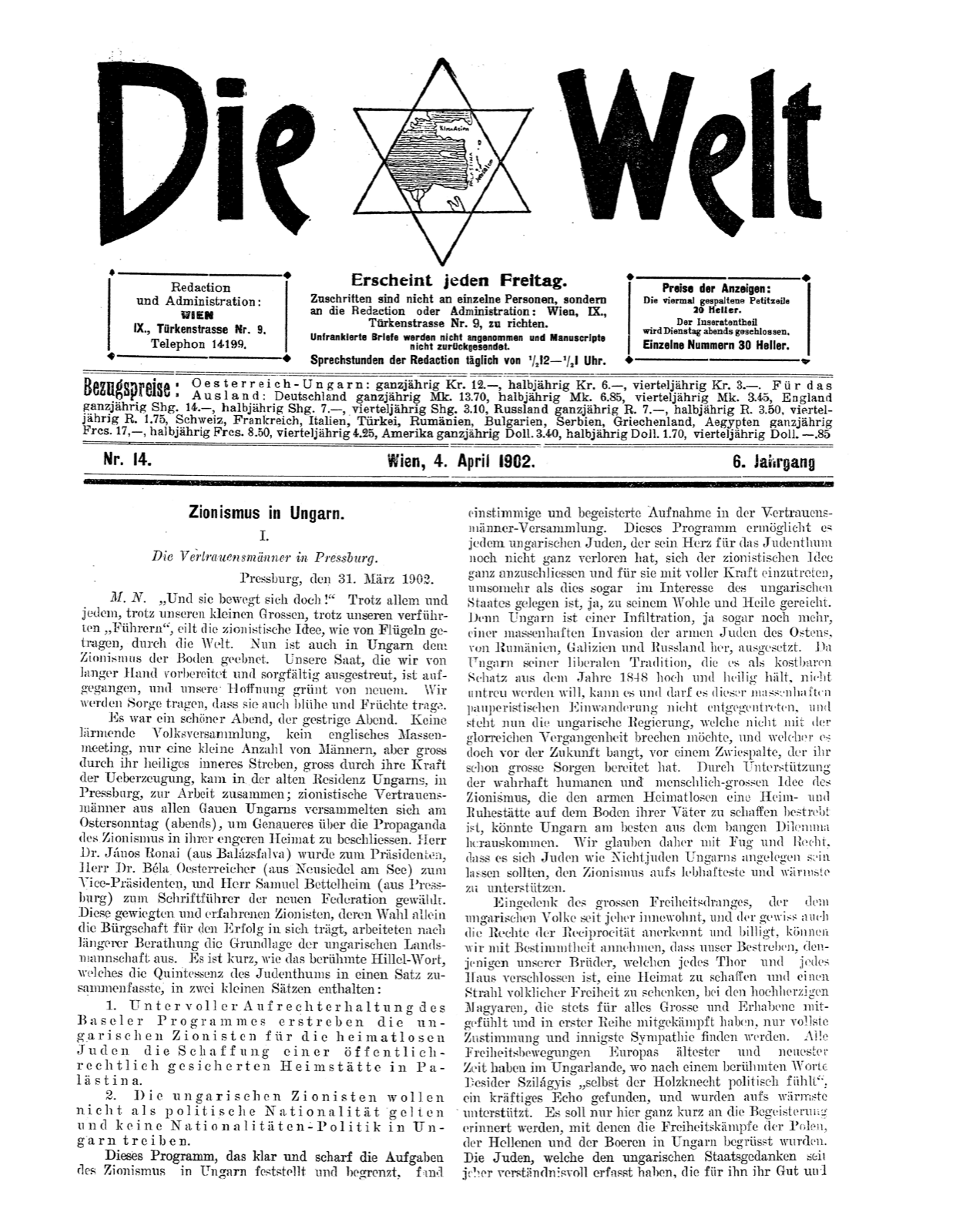
Die Welt
Editorial Office and Administration: VIENNA, IX., Türkenstrasse No. 9. Telephone 14199. Published every Friday. Correspondence is to be addressed not to individual persons but to the Editorial Office or the Administration: Vienna, IX., Türkenstrasse No. 9. Unstamped letters will not be accepted, and manuscripts will not be returned. Editorial office hours daily from ½12 to ½1 o'clock. Advertising rates: the four-column petit line, 20 Heller. The advertisement section closes on Tuesday evening. Single numbers 30 Heller.
Subscription rates: Austria-Hungary: yearly Kr. 12.—, half-yearly Kr. 6.—, quarterly Kr. 3.—. Abroad: Germany yearly Mk. 13.70, half-yearly Mk. 6.85, quarterly Mk. 3.45; England yearly Shg. 14.—, half-yearly Shg. 7.—, quarterly Shg. 3.10; Russia yearly R. 7.—, half-yearly R. 3.50, quarterly R. 1.75; Switzerland, France, Italy, Turkey, Roumania, Bulgaria, Servia, Greece, Egypt yearly Frcs. 17.—, half-yearly Frcs. 8.50, quarterly 4.25; America yearly Doll. 3.40, half-yearly Doll. 1.70, quarterly Doll. —.85
No. 14. | Vienna, 4 April 1902. | 6th Year
Zionism in Hungary.
I.
The Delegates at Pressburg.
Pressburg, 31 March 1902.
M. N. "And yet it moves!" In spite of all and everything, in spite of our little great men, in spite of our misled "leaders," the Zionist idea hastens through the world as though borne on wings. Now in Hungary, too, the ground has been levelled for Zionism. Our seed, which we long prepared and carefully sowed, has come up, and our hope grows green anew. We shall take care that it also blossoms and bears fruit.
It was a fine evening, yesterday evening. No noisy popular assembly, no English mass meeting, only a small number of men, but great through their sacred inner striving, great through the strength of their conviction, came together for work in the ancient royal seat of Hungary, in Pressburg; Zionist delegates from every district of Hungary assembled on Easter Sunday (in the evening) to resolve more precisely upon the propaganda of Zionism in their own more immediate homeland. Dr. János Ronai (of Balázsfalva) was elected President, Dr. Béla Oesterreicher (of Neusiedel am See) Vice-President, and Mr. Samuel Bettelheim (of Pressburg) Secretary of the new Federation. These seasoned and experienced Zionists, whose election alone carries within it the guarantee of success, after lengthy deliberation worked out the basis of the Hungarian Landsmannschaft. It is brief, like the celebrated saying of Hillel which summed up the quintessence of Judaism in a single sentence, and is contained in two short sentences:
-
In full maintenance of the Basle Programme, the Hungarian Zionists strive for the creation, for the homeless Jews, of a home in Palestine secured by public law.
-
The Hungarian Zionists do not wish to be regarded as a political nationality, nor to pursue any policy of nationalities in Hungary.
This programme, which clearly and sharply determines and delimits the tasks of Zionism in Hungary, met with unanimous and enthusiastic acceptance in the meeting of delegates. This programme makes it possible for every Hungarian Jew who has not yet wholly lost his heart for Judaism to join the Zionist idea fully and to champion it with all his strength, the more so since this lies even in the interest of the Hungarian State, nay, redounds to its welfare and salvation. For Hungary is exposed to an infiltration, nay, even more, to a mass invasion of the poor Jews of the East, from Roumania, Galicia and Russia. Since Hungary does not wish to be untrue to its liberal tradition, which it holds high and sacred as a precious treasure from the year 1848, it cannot and may not oppose this mass pauper immigration; and so the Hungarian Government, which would not break with its glorious past and yet fears for the future, stands before a dilemma which has already caused it great anxiety. By supporting the truly humane and humanly great idea of Zionism, which strives to create for the poor homeless a home and resting-place on the soil of their fathers, Hungary could best escape from this anxious dilemma. We therefore believe, with full right and reason, that Jews and non-Jews of Hungary alike should make it their concern to support Zionism most actively and most warmly.
Mindful of the great yearning for freedom which has ever dwelt in the Hungarian people, and which assuredly also acknowledges and approves the rights of reciprocity, we may assume with certainty that our endeavour to create a homeland, and to grant a ray of national freedom, for those of our brethren to whom every gate and every house is closed, will find nothing but the fullest assent and the most heartfelt sympathy among the high-minded Magyars, who have always felt with, and fought in the foremost rank for, all that is great and sublime. All the movements for freedom in Europe, of the oldest and of the most recent times, have found a powerful echo in the land of Hungary, where, in a celebrated phrase of Desider Szilágyi, "even the woodcutter feels politically," and have been most warmly supported. We need only recall here, quite briefly, the enthusiasm with which the struggles for freedom of the Poles, the Hellenes and the Boers were greeted in Hungary. The Jews, who have always understood the idea of the Hungarian State with sympathy, who for it their goods and