The World
Die Welt
Editorial Office and Administration: VIENNA IX., Türkenstrasse No. 9. Telephone 14199.
Published every Friday. Correspondence is to be addressed not to individual persons but to the Editorial Office or the Administration: Vienna, IX., Türkenstrasse No. 9. Unstamped letters are not accepted, and manuscripts are not returned. The Editorial Office receives callers daily from ½12 to ½1 o'clock.
Advertising rates: the four-column petit line, 20 Heller. The advertisement section closes on Tuesday evening. Single numbers, 30 Heller.
Subscription rates: Austria-Hungary: yearly Kr. 12.—, half-yearly Kr. 6.—, quarterly Kr. 3.—. Abroad: Germany yearly Mk. 13.70, half-yearly Mk. 6.85, quarterly Mk. 3.45; England yearly Shg. 14.—, half-yearly Shg. 7.—, quarterly Shg. 3.10; Russia yearly R. 7.—, half-yearly R. 3.50, quarterly R. 1.75; Switzerland, France, Italy, Turkey, Roumania, Bulgaria, Servia, Greece, Egypt yearly Frcs. 17.—, half-yearly Frcs. 8.50, quarterly 4.25; America yearly Doll. 3.40, half-yearly Doll. 1.70, quarterly Doll. —.85
No. 6. | Vienna, 7 February 1902. | 6th Year
Israel Zangwill against the "Ica."
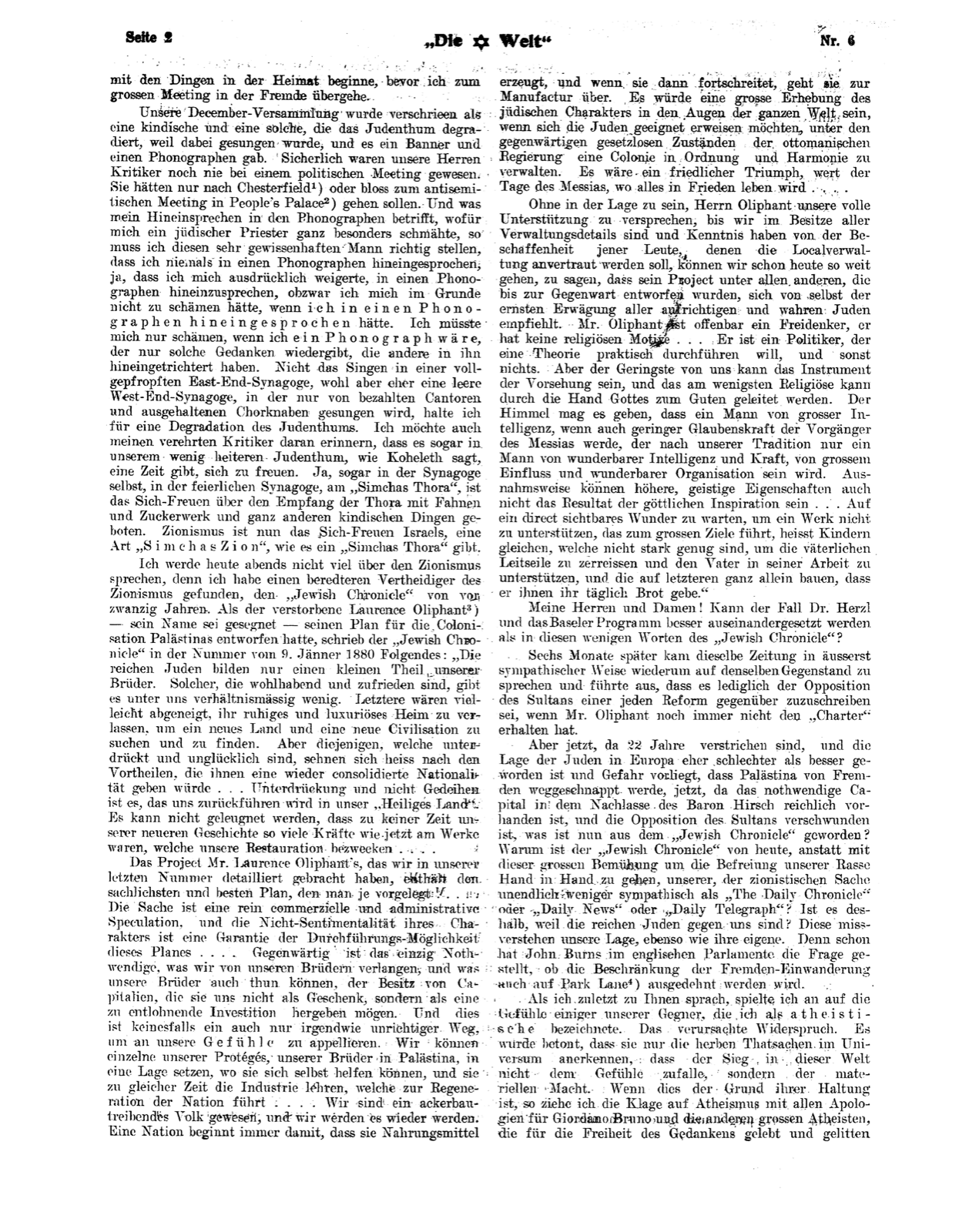
At a mass meeting held by the "English Zionist Federation" in London on Saturday, the 1st of February, our celebrated fellow-partisan Israel Zangwill gave his report on the Fifth Zionist Congress. He took this occasion also to repel sharply — with the full weight of his superior
[Portrait of Israel Zangwill]
powers of argument and with the whole persuasive force of the unwavering spokesman of a just cause — the many violent attacks that had been showered upon him for his manly Congress speech against the activity of the "Ica," attacks for which the leading organ of the English anti-Zionists, the "Jewish Chronicle," had in particular served as the instrument. It was shown afresh on this occasion how greatly our movement has been enriched by the personality of Israel Zangwill, and how generously he places all the gifts of his rich mind at the service of our national endeavours. The sovereign wit and the never-failing readiness with which he fell, to their utter destruction, upon the artfully constructed sophistical arguments of his assailants must overpower even all those to whom it was not granted to enjoy this speech in all its delightfulness as hearers. Against the assertions that the "Ica" is prevented by its statutes from employing the legacy of the late Baron Hirsch methodically in our sense, in accordance with the true interest of the Jewish people, Zangwill went through the statutes paragraph by paragraph and, with reference to the individual provisions, subjected the sham activity of the "Ica" to an unsparing criticism. He demonstrated that the "Ica," in restricting its operations to making presents of a number of cows and oxen to Jewish colonists in Argentina and to founding a few colourless schools in Russia and Roumania, turns the provisions of the statutes and the will of Baron Hirsch into their direct opposite. Of everything possible and useful — so Zangwill set forth — the statutes of the "Ica" speak: of railway construction and harbour works, of fortifications and canal building, yes, even of the charter in the flesh, such as political Zionism strives for; but the one thing of which the statutes breathe not a single syllable is the founding of schools, the show-piece in the annual reports of these statute-armoured gentlemen. The speaker quoted from the latest annual report of the "Ica" a particularly self-satisfied passage, according to which a German teacher engaged by the "Ica" in Argentina had learned Spanish in the shortest possible time... What is most admirable in Zangwill's masterly speech is the altogether incomparable manner in which he, the dreaded and censured "Wild One," softened the harsh sharpness of his truly irrefutable arguments by the courteous elegance of their form and by consummate tact and delicacy, and at the same time — precisely through this softening — made them all the more keenly felt. But it is impossible to do justice to this deed of Zangwill's by any general characterisation. Every single sentence of the speech shall speak for itself. With this intention we give here, in complete reproduction, this splendid work of art of political eloquence.
Israel Zangwill's Speech.
In the name of all the English delegates, as in my own name, I thank you most heartily for our kind reception on our return home from the toils and labours of the Congress. Since you sent us on our way, since I last had the honour of speaking to you from this platform, much water has flowed under the bridge, and very much indeed under the bridge over the Rhine at Basle. The meeting which we held in this hall on the 14th of December 1901 still affords us ample matter for a lively discussion, and therefore I make no apology for