The World
Die Welt
Appears every Friday.
Editorial Office and Administration: VIENNA IX., Türkenstrasse No. 9. Telephone 14199.
Communications are to be addressed not to individual persons but to the Editorial Office or the Administration: Vienna, IX., Türkenstrasse No. 9. Unstamped letters are not accepted, and manuscripts are not returned. Editorial consulting hours daily from 1/212—1/21 o'clock.
Advertising rates: the four-column petit line, 20 Heller. The advertisement section closes on Tuesday evening. Single numbers 30 Heller.
Subscription rates: Austria-Hungary: yearly Kr. 12.—, half-yearly Kr. 6.—, quarterly Kr. 3.—. Abroad: Germany yearly Mk. 13.70, half-yearly Mk. 6.85, quarterly Mk. 3.45; England yearly Shg. 14.—, half-yearly Shg. 7.—, quarterly Shg. 3.10; Russia yearly R. 7.—, half-yearly R. 3.50, quarterly R. 1.75; Switzerland, France, Italy, Turkey, Roumania, Bulgaria, Servia, Greece, Egypt yearly Frcs. 17.—, half-yearly Frcs. 8.50, quarterly 4.25; America yearly Doll. 3.40, half-yearly Doll. 1.70, quarterly Doll. —.85
No. 5. | Vienna, 31 January 1902. | 6th Year
The Bagdad Railway and Palestine.
In the age of steam and electricity, great railway projects no longer astonish us. On the contrary! We should be astonished if our daily newspapers and our capitalists did not occupy themselves with the building of great, world-shaking and world-moving means of communication. After the great Siberian Railway, which is the milestone in the history of human progress, with which the "iron century" — the century of technology and reform, of discoveries and inventions par excellence — closed, covered with glory, there comes the Bagdad Railway, with which the twentieth century has worthily made its beginning. Not so gigantic in plan nor so vast in design as the Great-Asiatic line, the "Asia Minor railway" nevertheless signifies a great work of culture and civilisation. Nay, it signifies still more: it is a piece of the history of requital. The Bagdad Railway, which German shareholders and German labour are building in Turkish Asia Minor, is the thanks of Europe, of the Occident, expressed in deeds, for the light and enlightenment of Asia, of the Orient, which was the cradle of our culture. The modern Europeans do not bring enlightenment and civilised manners on the sharp points of bayonets, nor upon great ships of war, as was the custom and usage in antiquity; they do not gird themselves with the sword in order to make conquests, but under the sign of peace they create works of peace, of freedom, of culture and of civilisation, and thereby they win the fairest victories. Our social age is not well disposed toward raging war; it is not the playground of venal hosts of mercenaries who have made war their trade, but the field of peaceable men who do not destroy and tear down, but steadily build up and create anew. The pioneer has relieved the soldier, and the iron of the sword has unawares, as the prophet foretold, been changed into that of the ploughshare.
Nowadays no one will any longer fail to recognise, or even rate lightly, the high civilising and cultural-historical value of railways. The iron bonds which link countries together also bind hearts to one another, and contribute to the happiness of all mankind, which is beginning to feel itself as one family. Formerly men were not insensible to the sufferings and torments of their neighbour; now they already share in the misfortune and woe of the neighbouring realm; the means of communication have brought us so near, have joined us so closely together, that we in the West fancy we can hear the groans and laments of our brethren in the East: modern technology has moved us closer to one another. And therefore, when a railway is built "far down in Turkey," it holds interest also for the Westerner, who is so far from it and yet so near. The rise and flourishing of one realm react upon all other states and countries: that is the modern relation of reciprocity, which equalises the states materially and economically.
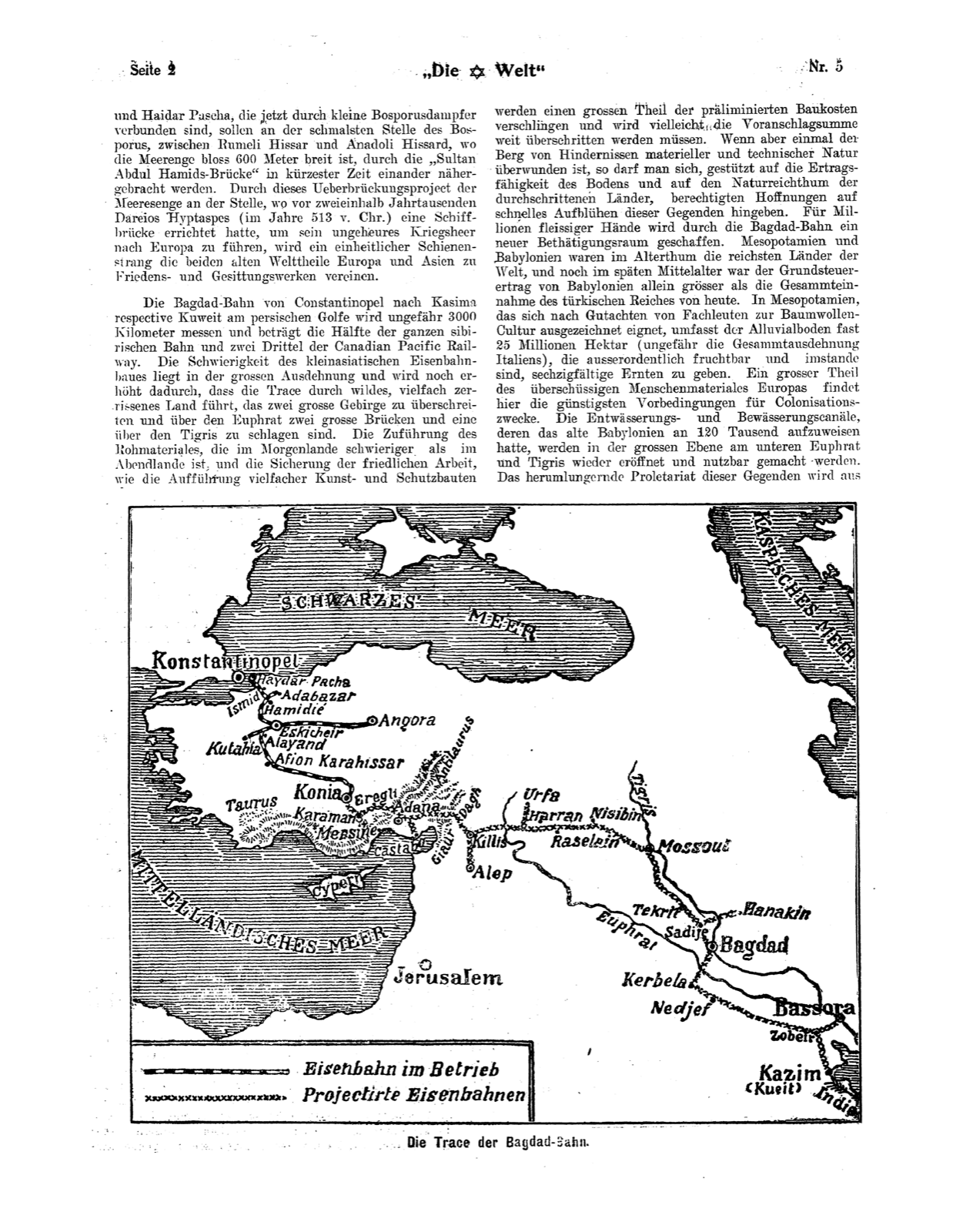
The Irade which grants the concession for the Bagdad Railway was given by Sultan Abdul Hamid, as it were, as a New Year's gift to the German Railway Company of Anatolia. The route of the projected Bagdad Railway, as it was fixed in the negotiations between the Sublime Porte in Constantinople and the Board of Directors of the Anatolian Railway Company, is drawn in our accompanying sketch-map. The new railway starts from Konia, the present terminus of the "German line" from Haidar Pascha (opposite Constantinople) to Konia, with a branch to Angora and an operating length of 1023 kilometres; it crosses the Taurus between Eregli and Adana, touches Osmanie, Kilis and Tell Habesch, passes over the Euphrates to Harran, and runs by way of Raselain, Helif and Nisibin to Mossul on the Tigris. From there the railway keeps to the right bank of the Tigris as far as Bagdad, then crosses the Euphrates a second time and reaches Kerbela, the well-known Shiite place of pilgrimage. The main line now runs along the right bank of the Euphrates toward Zobeir, where it divides, one branch going to Bassora and the other to Kasima, which is the most favourable harbour of Kuweit on the Persian Gulf. Branch lines will lead from the Taurus (Adana) to the sea, from Kilis to Aleppo, the capital of the vilayet of the same name, from Harran to Urfa, and from Sadidje to Hanakin on the Persian frontier. The whole line from Konia to Kasima amounts to approximately 2300 kilometres, and the cost is estimated at about 600 million francs.
The already completed line, 650 kilometres long, from Haidar Pascha on the Bosphorus to Konia in Anatolia is to be regarded as the first link of the new Bagdad Railway. Stamboul