The World
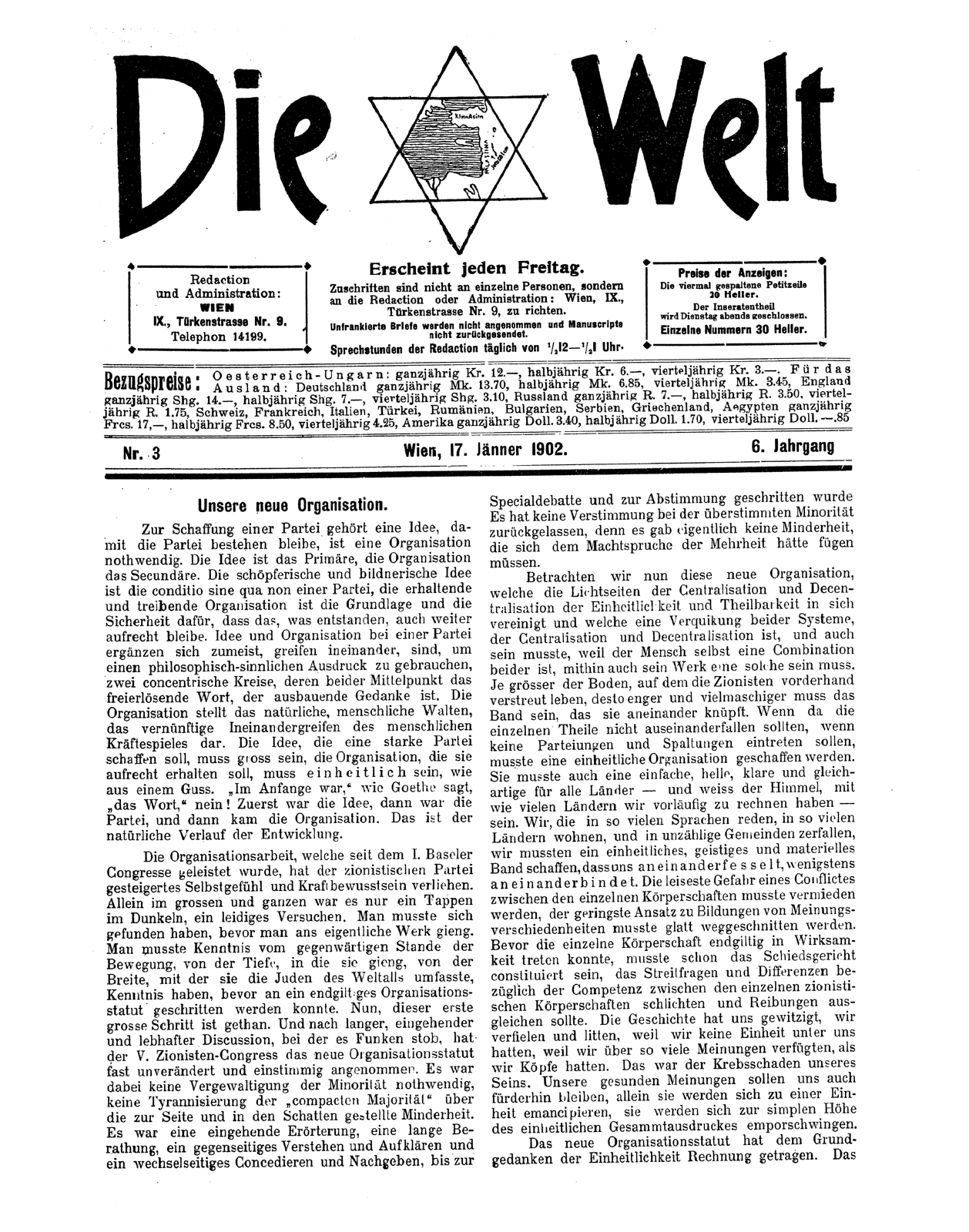
Die Welt
Published every Friday. Editorial office and administration: Vienna, IX., Türkenstrasse No. 9. Telephone 14199. Correspondence is to be addressed not to individual persons but to the Editorial Office or the Administration: Vienna, IX., Türkenstrasse No. 9. Unstamped letters are not accepted, and manuscripts are not returned. The editors' office hours are daily from half-past eleven to half-past twelve.
Advertising rates: the four-column petit line, 20 Heller. The advertisement section closes on Tuesday evening. Single numbers 30 Heller.
Subscription rates: Austria-Hungary: yearly Kr. 12.—, half-yearly Kr. 6.—, quarterly Kr. 3.—. Abroad: Germany yearly Mk. 13.70, half-yearly Mk. 6.85, quarterly Mk. 3.45; England yearly Shg. 14.—, half-yearly Shg. 7.—, quarterly Shg. 3.10; Russia yearly R. 7.—, half-yearly R. 3.50, quarterly R. 1.75; Switzerland, France, Italy, Turkey, Roumania, Bulgaria, Servia, Greece, Egypt yearly Frcs. 17.—, half-yearly Frcs. 8.50, quarterly 4.25; America yearly Doll. 3.40, half-yearly Doll. 1.70, quarterly Doll. —.85
No. 3 / Vienna, 17 January 1902. / 6th Year
Our New Organisation.
To the creation of a party an idea is requisite; that the party may endure, an organisation is necessary. The idea is the primary thing, the organisation the secondary. The creative and formative idea is the conditio sine qua non of a party; the sustaining and impelling organisation is the foundation and the guarantee that what has come into being shall also remain standing. Idea and organisation in a party for the most part complement each other, interlock, and are, to use a philosophic-sensuous expression, two concentric circles whose common centre is the freely redeeming word, the building thought. Organisation represents the natural, human working, the rational interplay of the play of human forces. The idea that is to create a strong party must be great; the organisation that is to maintain it must be uniform, as if cast in one mould. "In the beginning was," as Goethe says, "the Word"; nay! First there was the idea, then there was the party, and then came the organisation. That is the natural course of development.
The work of organisation accomplished since the First Basle Congress has lent the Zionist party a heightened self-confidence and consciousness of strength. Yet on the whole it was only a groping in the dark, a wearisome experimenting. We had first to find ourselves before we went to the real work. We had to gain knowledge of the present state of the movement, of the depth to which it went, of the breadth with which it embraced the Jews of the whole world, before a definitive statute of organisation could be undertaken. Now, this first great step has been taken. And after long, thorough and lively discussion, in which the sparks flew, the Fifth Zionist Congress adopted the new statute of organisation almost unaltered and unanimously. No coercion of the minority was needed, no tyrannising of the "compact majority" over a minority thrust aside and into the shade. There was thorough deliberation, long consultation, a mutual understanding and enlightenment and a reciprocal conceding and yielding, before the debate on particulars and the vote were proceeded to. It left behind no ill-humour in an outvoted minority, for there was in truth no minority that had to bow to the decree of the majority.
Let us now consider this new organisation, which unites within itself the bright sides of centralisation and decentralisation, of unity and divisibility, and which is an amalgamation of both systems, centralisation and decentralisation, and indeed had to be, because man himself is a combination of both, and consequently his work too must be such. The wider the ground over which the Zionists for the present live scattered, the closer and finer-meshed must be the bond that ties them to one another. If the individual parts were not to fall asunder, if no factions and schisms were to arise, a uniform organisation had to be created. It had, moreover, to be simple, bright, clear and alike for all countries — and Heaven knows with how many countries we have for the present to reckon. We, who speak in so many tongues, dwell in so many lands, and are divided into innumerable communities, had to create a uniform spiritual and material bond that should chain us together, or at least bind us together. The faintest danger of a conflict between the individual bodies had to be avoided; the least beginning of a formation of differences of opinion had to be cut clean away. Before the individual body could definitively enter upon its activity, the Court of Arbitration had already to be constituted, which was to settle questions in dispute and differences regarding competence between the individual Zionist bodies and to smooth away frictions. History has made us wise; we declined and suffered because we had no unity among us, because we possessed as many opinions as we had heads. That was the canker of our existence. Our sound opinions shall remain ours henceforth as well, but they will emancipate themselves into a unity; they will soar up to the simple height of a uniform collective expression.
The new statute of organisation has taken account of the fundamental idea of unity. That