The World
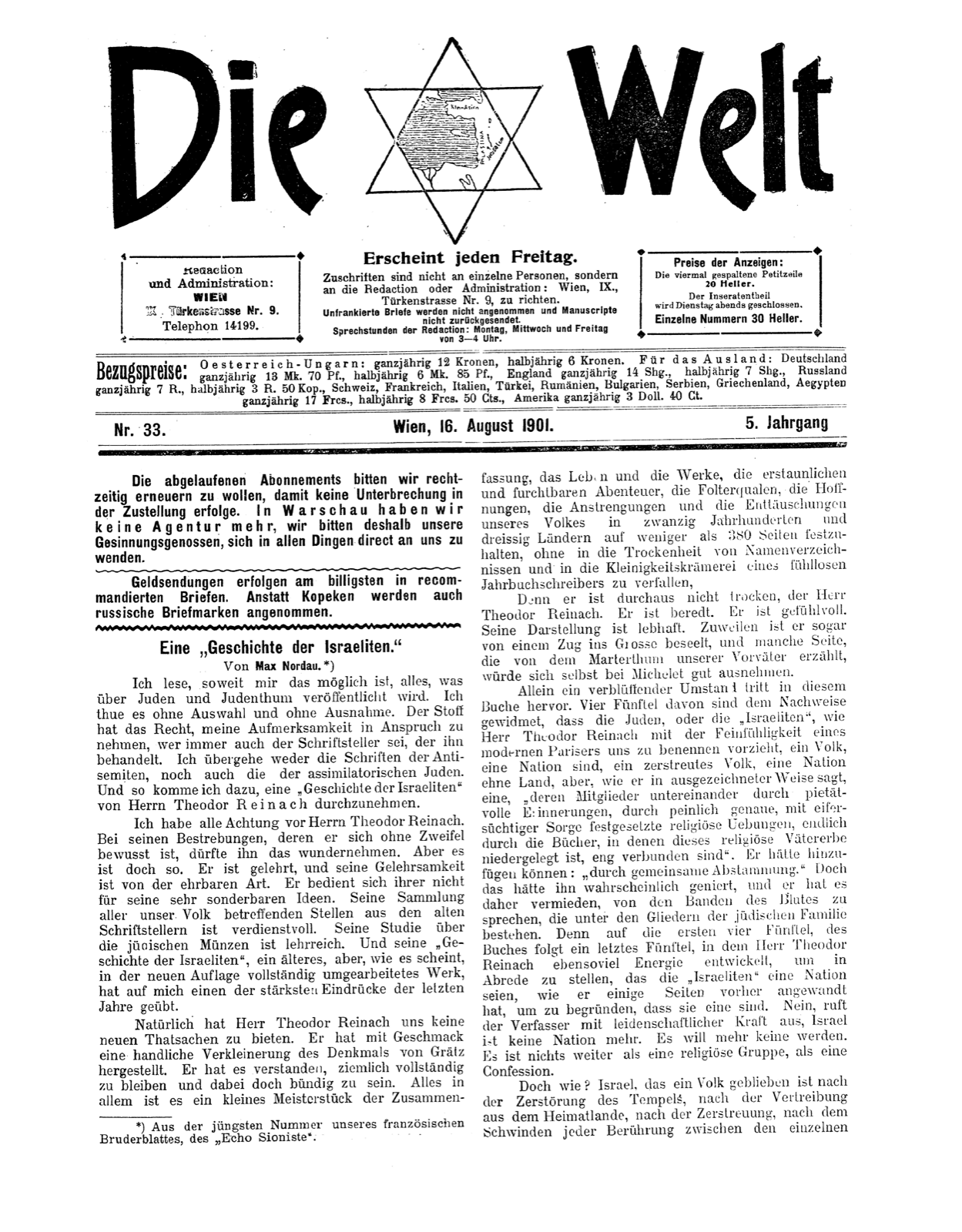
Die Welt
Editorial Office and Administration: VIENNA IX., Türkenstrasse No. 9. Telephone 14199.
Appears every Friday. Communications are to be addressed not to individual persons, but to the Editorial Office or the Administration: Vienna, IX., Türkenstrasse No. 9. Unstamped letters are not accepted, and manuscripts are not returned. Office hours of the Editorial Office: Monday, Wednesday and Friday from 3 to 4 o'clock.
Rates for advertisements: the four-column petit line 20 Heller. The advertisement section closes Tuesday evening. Single numbers 30 Heller.
Subscription rates: Austria-Hungary: 12 Kronen yearly, 6 Kronen half-yearly. For abroad: Germany 13 Mk. 70 Pf. yearly, 6 Mk. 85 Pf. half-yearly; England 14 Shg. yearly, 7 Shg. half-yearly; Russia 7 R. yearly, 3 R. 50 Kop. half-yearly; Switzerland, France, Italy, Turkey, Roumania, Bulgaria, Servia, Greece, Egypt 17 Frcs. yearly, 8 Frcs. 50 Cts. half-yearly; America 3 Doll. 40 Ct. yearly.
No. 33. | Vienna, 16 August 1901. | 5th Year
We beg that expired subscriptions be renewed in good time, so that no interruption may occur in the delivery. In Warsaw we no longer have an agency, and we therefore beg our friends of like mind to apply to us directly in all matters.
Remittances of money are made most cheaply in registered letters. In place of copecks, Russian postage stamps are also accepted.
A "History of the Israelites."
By Max Nordau.*)
I read, so far as that is possible to me, everything that is published concerning Jews and Judaism. I do it without selection and without exception. The subject has the right to claim my attention, whoever the writer may be who treats of it. I pass over neither the writings of the antisemites nor those of the assimilationist Jews. And so I come to work through a "History of the Israelites" by Mr. Theodor Reinach.
I have every respect for Mr. Theodor Reinach. In view of his endeavours, of which he is doubtless conscious, this may well astonish him. But so it is. He is learned, and his learning is of the honourable sort. He does not make use of it for his very singular ideas. His collection of all the passages in the ancient writers that concern our people is meritorious. His study of the Jewish coins is instructive. And his "History of the Israelites," an older work, but one which, as it appears, has been completely recast in the new edition, has made upon me one of the strongest impressions of recent years.
Naturally Mr. Theodor Reinach has no new facts to offer us. He has produced, with taste, a handy reduction of the monument of Grätz. He has understood how to remain tolerably complete and yet withal to be concise. All in all it is a little masterpiece of condensa-
*) From the latest number of our French sister-paper, the "Echo Sioniste".
tion, to hold fast in less than 380 pages the life and the works, the astonishing and frightful adventures, the torments, the hopes, the exertions and the disappointments of our people through twenty centuries and thirty lands, without falling into the dryness of a catalogue of names and into the petty pedantry of an unfeeling chronicler.
For he is by no means dry, this Mr. Theodor Reinach. He is eloquent. He is full of feeling. His presentation is lively. At times he is even animated by a touch of grandeur, and many a page that tells of the martyrdom of our forefathers would look well even in Michelet.
Yet one astounding circumstance stands out in this book. Four-fifths of it are devoted to the demonstration that the Jews, or the "Israelites," as Mr. Theodor Reinach, with the delicacy of a modern Parisian, prefers to name us, are a people, a nation, a scattered people, a nation without a land, but one, as he says in excellent fashion, "whose members are closely bound to one another by pious recollections, by scrupulously exact religious observances fixed with jealous care, and finally by the books in which this religious ancestral inheritance is laid down." He might have added: "by common descent." But that would probably have embarrassed him, and he has therefore avoided speaking of the ties of blood that subsist among the members of the Jewish family. For upon the first four-fifths of the book there follows a last fifth, in which Mr. Theodor Reinach develops just as much energy to deny that the "Israelites" are a nation as he had employed some pages earlier to establish that they are one. No, cries the author with passionate force, Israel is a nation no longer. It will no longer become one. It is nothing further than a religious group, than a confession.
Yet how? Israel, which has remained a people after the destruction of the Temple, after the expulsion from the homeland, after the dispersion, after the vanishing of every contact between the several