The World
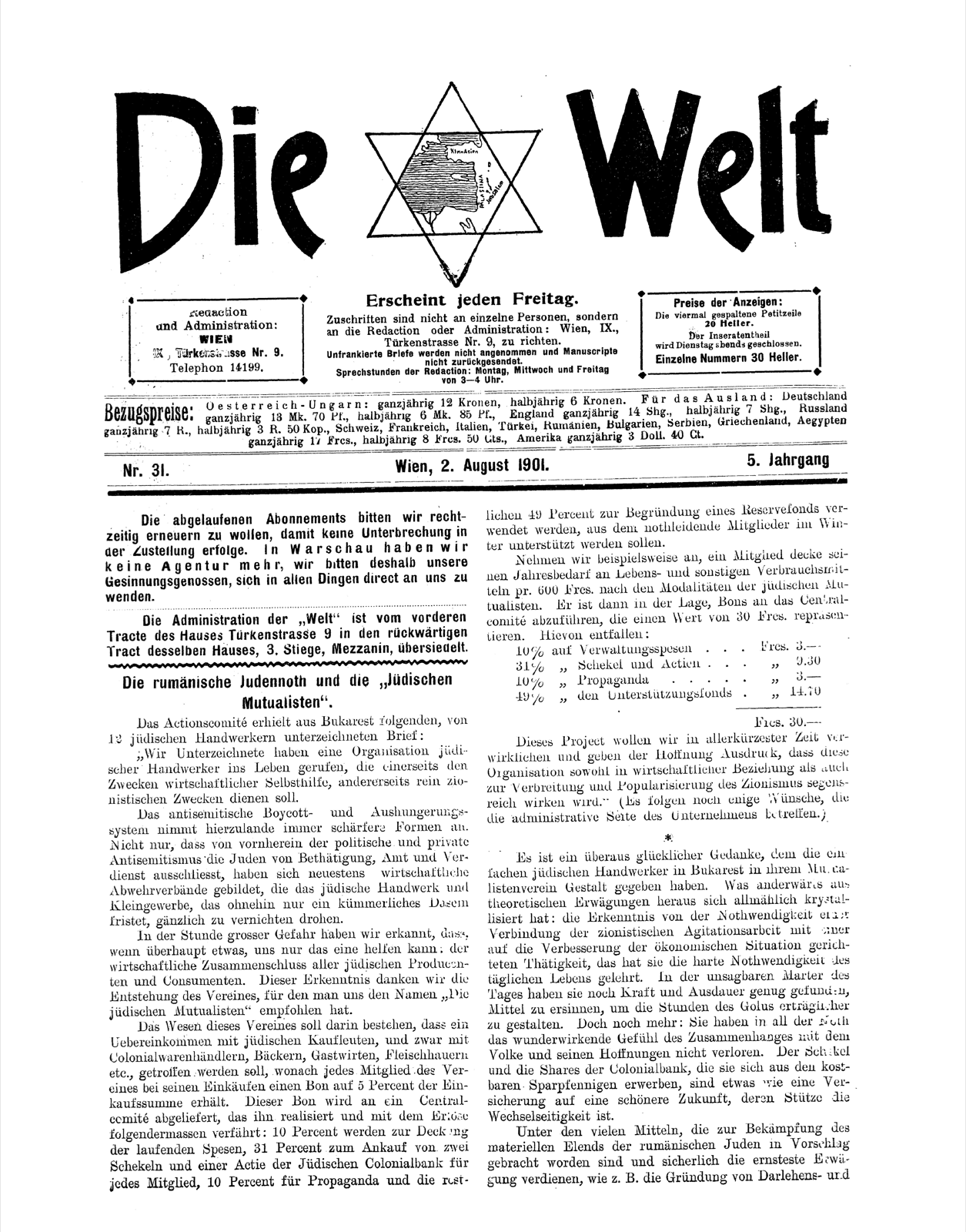
Die Welt
Appears every Friday.
Editorial Office and Administration: VIENNA, IX., Türkenstrasse Nr. 9. Telephone 14199. Communications are to be addressed not to individual persons, but to the Editorial Office or the Administration: Vienna, IX., Türkenstrasse Nr. 9. Unstamped letters are not accepted, and manuscripts are not returned. Office hours of the Editorial Office: Monday, Wednesday and Friday, from 3–4 o'clock.
Rates of advertisement: the four-column petit line, 20 Heller. The advertisement section closes Tuesday evening. Single numbers 20 Heller.
Subscription rates: Austria-Hungary: yearly 12 Kronen, half-yearly 6 Kronen. For abroad: Germany yearly 13 Mk. 70 Pf., half-yearly 6 Mk. 85 Pf.; England yearly 14 Shg., half-yearly 7 Shg.; Russia yearly 7 R., half-yearly 3 R. 50 Kop.; Switzerland, France, Italy, Turkey, Roumania, Bulgaria, Servia, Greece, Egypt yearly 17 Frcs., half-yearly 8 Frcs. 50 Cts.; America yearly 3 Doll. 40 Ct.
No. 31. | Vienna, August 2, 1901. | Vol. V
We beg that expired subscriptions may be renewed in good time, so that no interruption in delivery may occur. We have no agency in Warsaw any longer, and therefore beg our fellow-adherents to apply to us directly in all matters.
The Administration of the "Welt" has removed from the front wing of the house Türkenstrasse 9 into the rear wing of the same house, 3rd staircase, mezzanine.
The Roumanian Jewish Distress and the "Jewish Mutualists".
The Actions Committee has received from Bucharest the following letter, signed by 12 Jewish artisans:
"We the undersigned have called into being an organisation of Jewish artisans which is to serve, on the one hand, the purposes of economic self-help, and on the other purely Zionist purposes.
The antisemitic system of boycott and starvation is assuming ever sharper forms in this country. Not only does political and private antisemitism from the outset exclude the Jews from occupation, office and earnings; of late there have also been formed economic defence associations which threaten to annihilate entirely the Jewish handicraft and small trade, which in any case eke out but a wretched existence.
In the hour of great danger we have recognised that, if anything at all can help us, one thing alone can do so: the economic union of all Jewish producers and consumers. To this recognition we owe the origin of the society, for which the name "The Jewish Mutualists" has been recommended to us.
The essence of this society is to consist in an agreement to be concluded with Jewish tradesmen, namely with grocers, bakers, innkeepers, butchers, etc., according to which every member of the society shall receive, upon his purchases, a voucher for 5 per cent. of the sum purchased. This voucher is delivered up to a Central Committee, which realises it and deals with the proceeds as follows: 10 per cent. will be applied to the covering of current expenses, 31 per cent. to the purchase of two shekels and one share of the Jewish Colonial Bank for every member, 10 per cent. to propaganda, and the remaining 49 per cent. to the founding of a reserve fund out of which members in distress are to be supported during the winter.
Let us assume, for example, that a member covers his yearly requirements in provisions and other articles of consumption to the amount of 600 Frcs. according to the arrangements of the Jewish Mutualists. He is then in a position to deliver up to the Central Committee vouchers representing a value of 30 Frcs. Of this there fall:
| 10% to administrative expenses | . . . . . | Frcs. 3.— |
| 31% " shekels and shares | . . . . . | " 9.30 |
| 10% " propaganda | . . . . . | " 3.— |
| 49% " the relief fund | . . . . . | " 14.70 |
| Frcs. 30.— |
This project we intend to realise within the very shortest time, and we give expression to the hope that this organisation will work beneficially both in the economic respect and for the spread and popularisation of Zionism." (There follow some further wishes, concerning the administrative side of the undertaking.)
<center>\*</center>It is an exceedingly happy thought to which the simple Jewish artisans of Bucharest have given form in their Mutualist society. What elsewhere has gradually crystallised out of theoretical considerations — the recognition of the necessity of joining the work of Zionist agitation with an activity directed to the improvement of the economic situation — that they have been taught by the hard necessity of daily life. Amid the unspeakable torment of the day they have still found strength and endurance enough to devise means of making the hours of the Golus more endurable. But more than this: in all their distress they have not lost the wonder-working feeling of connection with the people and its hopes. The shekel and the shares of the Colonial Bank, which they acquire out of their precious saved pence, are something like an insurance upon a fairer future, whose support is mutuality.
Among the many means that have been proposed for combating the material misery of the Roumanian Jews, and that certainly deserve the most earnest consideration — as, for instance, the founding of loan and