The World
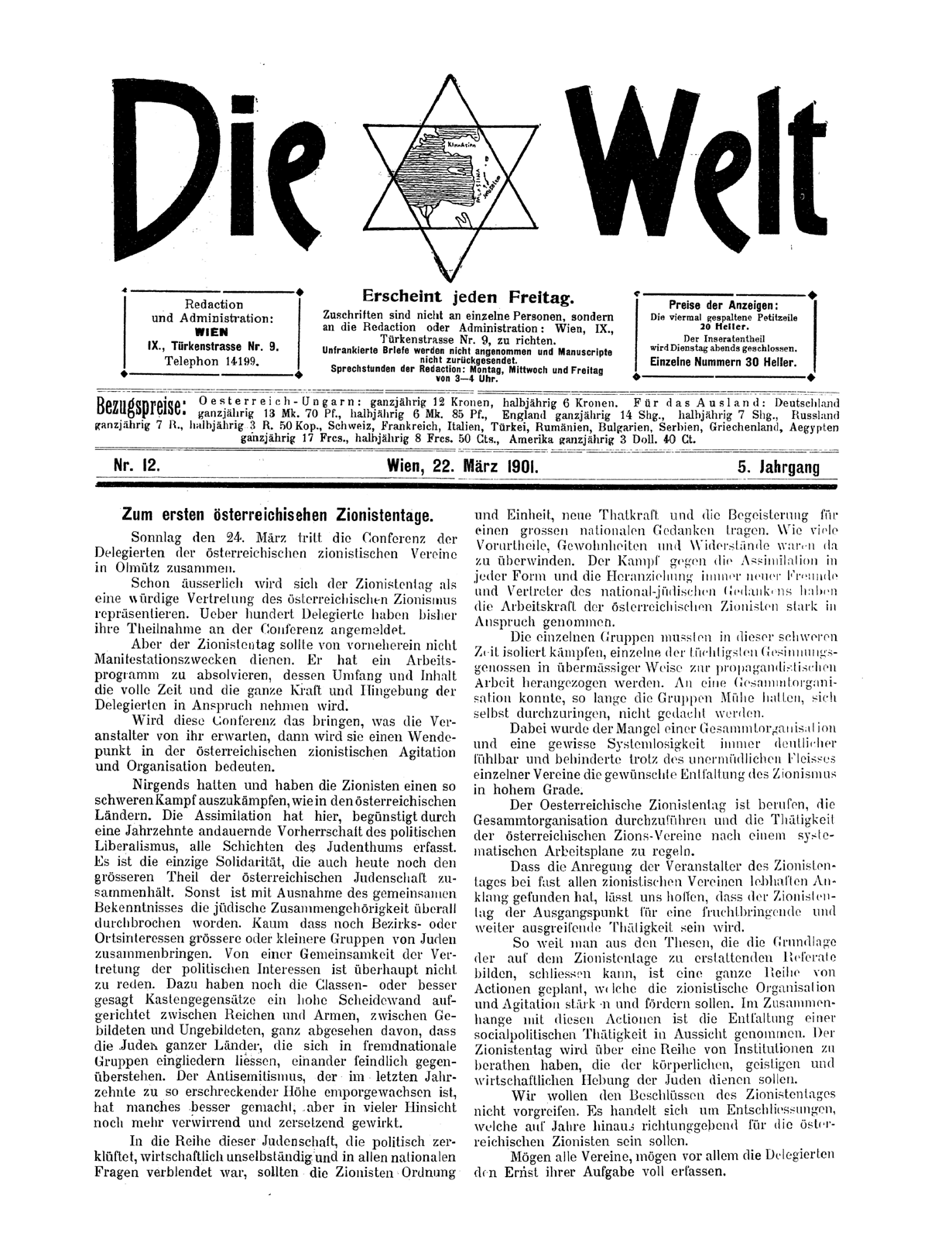
Die Welt
Appears every Friday.
Editorial Office and Administration: VIENNA IX., Türkenstrasse No. 9. Telephone 14199.
Communications are to be addressed not to individual persons, but to the Editorial Office or the Administration: Vienna, IX., Türkenstrasse No. 9. Unstamped letters are not accepted, and manuscripts are not returned. Editorial hours: Monday, Wednesday and Friday, from 3—4 o'clock.
Advertising rates: The four-column petit line, 20 Heller. The advertisement section closes Tuesday evening. Single numbers 30 Heller.
Subscription rates: Austria-Hungary: yearly 12 Kronen, half-yearly 6 Kronen. For abroad: Germany yearly 13 Mk. 70 Pf., half-yearly 6 Mk. 85 Pf.; England yearly 14 Shg., half-yearly 7 Shg.; Russia yearly 7 R., half-yearly 3 R. 50 Kop.; Switzerland, France, Italy, Turkey, Roumania, Bulgaria, Servia, Greece, Egypt yearly 17 Frcs., half-yearly 8 Frcs. 50 Cts.; America yearly 3 Doll. 40 Ct.
No. 12. Vienna, 22 March 1901. Fifth Year
To the First Austrian Zionist Conference.
On Sunday, the 24th of March, the conference of the delegates of the Austrian Zionist societies assembles at Olmütz.
Even outwardly the Zionist Conference will present itself as a worthy representation of Austrian Zionism. More than a hundred delegates have thus far announced their participation in the conference.
But the Zionist Conference was from the outset not meant to serve the purposes of a demonstration. It has a programme of work to accomplish whose extent and content will claim the whole time and the entire strength and devotion of the delegates.
If this conference brings what its promoters expect of it, then it will signify a turning point in Austrian Zionist agitation and organisation.
Nowhere have the Zionists had, and nowhere have they still, so hard a struggle to fight out as in the Austrian lands. Assimilation here, favoured by a predominance of political Liberalism enduring for decades, has laid hold of every stratum of Jewry. It is the only solidarity which even to-day holds together the greater part of Austrian Jewry. For the rest, with the exception of the common confession of faith, Jewish cohesion has everywhere been broken through. Scarcely do district or local interests still bring larger or smaller groups of Jews together. Of any community in the representation of political interests there can be no talk whatever. Beyond this, the class — or better said the caste — antagonisms have raised a high partition wall between rich and poor, between the educated and the uneducated, quite apart from the fact that the Jews of whole lands, who have suffered themselves to be incorporated into foreign national groups, stand over against one another as enemies. Antisemitism, which in the last decade has grown up to so terrifying a height, has made some things better, but in many respects has worked yet more confusingly and disintegratingly.
Into the ranks of this Jewry, which was politically riven, economically unindependent and blinded in all national questions, the Zionists were to carry order and unity, new energy, and enthusiasm for a great national idea. How many prejudices, habits and resistances were there to be overcome. The struggle against assimilation in every form, and the drawing in of ever new friends and representatives of the Jewish-national idea, have laid heavy claim upon the working power of the Austrian Zionists.
The several groups had in this hard time to fight in isolation, and some of the ablest comrades in conviction had to be drawn upon in excessive measure for propagandist work. Of a general organisation there could be no thought so long as the groups had trouble enough in struggling through by themselves.
Withal the want of a general organisation and a certain lack of system made themselves ever more distinctly felt, and, despite the untiring industry of individual societies, hindered in a high degree the desired unfolding of Zionism.
The Austrian Zionist Conference is called to carry through the general organisation and to regulate the activity of the Austrian Zion societies according to a systematic plan of work.
That the suggestion of the promoters of the Zionist Conference has met with a lively response among almost all the Zionist societies allows us to hope that the Conference will be the starting point of a fruitful and more widely reaching activity.
So far as one may conclude from the theses which form the basis of the reports to be delivered at the Conference, a whole series of actions is planned which are to strengthen and further Zionist organisation and agitation. In connection with these actions the unfolding of a social-political activity is contemplated. The Conference will have to deliberate upon a series of institutions which are to serve the physical, intellectual and economic raising of the Jews.
We do not wish to anticipate the resolutions of the Conference. What is in question are decisions which for years to come are to give the direction to the Austrian Zionists.
May all the societies, and above all the delegates, fully grasp the seriousness of their task.