The World
Die Welt
Editorial and Business Offices: VIENNA IX., Türkenstrasse No. 9. Telephone 14199. — Published every Friday. Communications are to be addressed not to individual persons, but to the Editorial or Business Office: Vienna, IX., Türkenstrasse No. 9. Unstamped letters are not accepted, and manuscripts are not returned. Editorial hours: Monday, Wednesday and Friday, from 3 to 4 o'clock. — Advertising rates: the four-column petit line, 20 Heller. The advertising section closes on Tuesday evening. Single numbers 30 Heller.
Subscription rates: Austria-Hungary: yearly 12 Kronen, half-yearly 6 Kronen. For abroad: Germany yearly 13 Mk. 70 Pf., half-yearly 6 Mk. 85 Pf.; England yearly 14 shg., half-yearly 7 shg.; Russia yearly 7 R., half-yearly 3 R. 50 Kop.; Switzerland, France, Italy, Turkey, Roumania, Bulgaria, Servia, Greece, Egypt yearly 17 frcs., half-yearly 8 frcs. 50 cts.; America yearly 3 doll. 40 ct.
| No. 6. | Vienna, 8th February 1901. | Fifth Year |
|---|
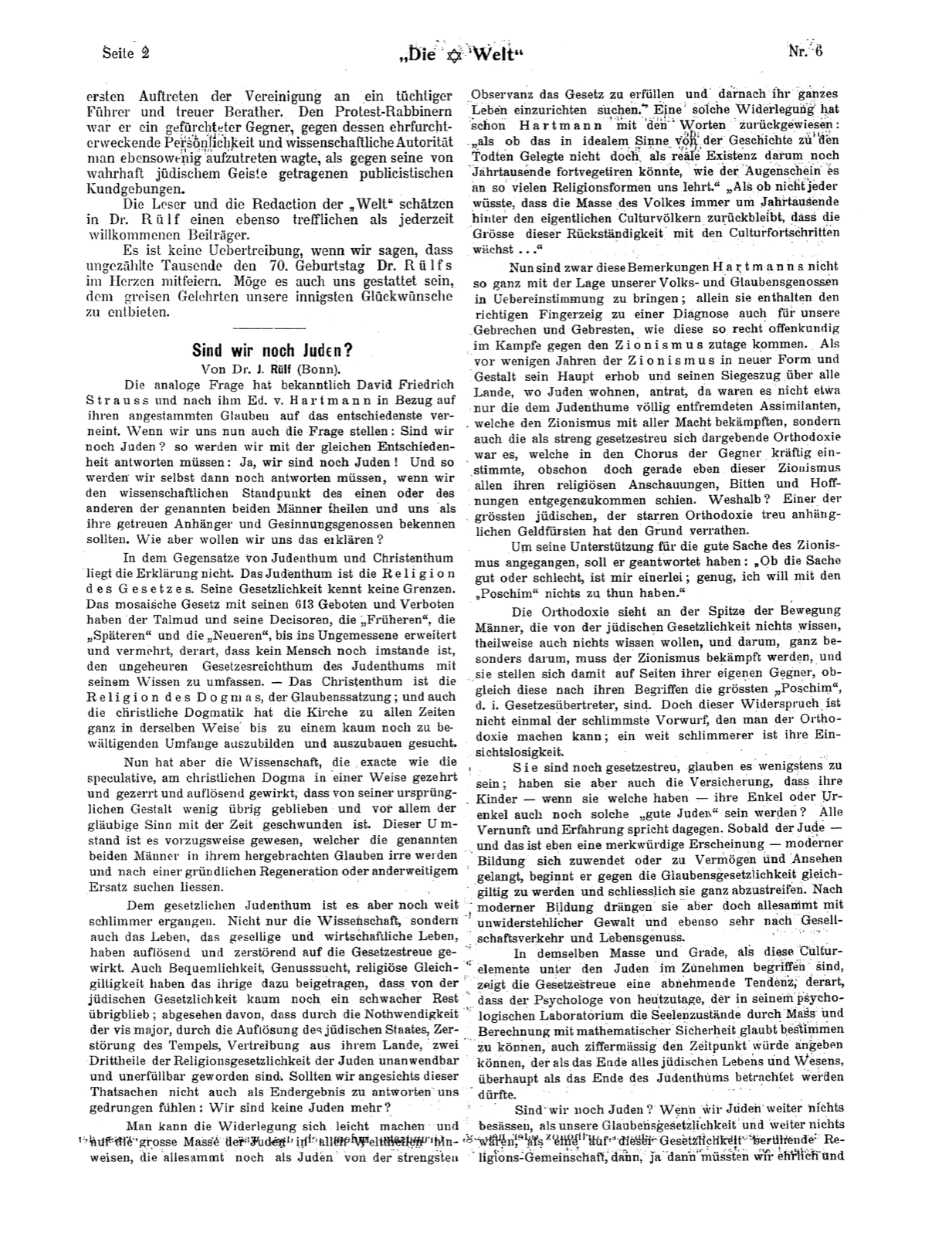
Rabbi Dr. I. Rülf.
(On his 70th birthday — 10th February 1901.)
Our distinguished comrade in conviction was born on the 10th of February 1831 at Rauisch-Holzhausen in Hesse. After a careful preparation directed towards the study of the rabbinate, he passed the teachers' examination in the year 1849, and was then active as a teacher at Gudensberg near Cassel. In 1854 he entered the University of Marburg, and in 1857 passed the rabbinical examination. From 1859 to 1863 we see him as teacher and preacher in a small town of the Grand Duchy of Hesse, and thence until November 1865 as teacher of religion and rabbinical assistant in Mecklenburg-Schwerin. In the same year he took the degree of Doctor of Philosophy at the University of Rostock, and entered upon his post at Memel as rabbi. With his assumption of this post in the frontier town there began at the same time his zealous activity on behalf of the poor and the suffering. In the year 1867, when the grievous distress broke out in East Prussia, there was formed, under the protection of the then Crown Prince Frederick William, a Relief Committee, of which Rülf was the soul. In order to be able to help the hundreds of destitute Jewish families who had immigrated from Russia, he began a collection among the German Jews. From that time until April 1898 relief work formed the very element of Rülf's life. In the year 1871 he was elected secretary of the Relief Society, and as such he wrote the annual reports down to the year 1897. When in that terrible year of want the Russian Jews beyond the frontier also turned to Memel for support, the worst famine prevailing there, a Relief Committee was formed under Rülf's presidency, which in two years collected over half a million marks and distributed it in weekly relief among 230 localities. What has since been done for the relief of the Russian Jews in famine, conflagration and persecution can hardly be described. Two permanent institutions in Memel owe their origin to Rülf's labours: the Israelitish hospital founded in the year 1870, and the Israelitish school for the poor. From that time date also Rülf's first writings: "My Journey to Kowno" (1869), "Three Days in Jewish Russia" (1881), "Aruchas Bas-Ami" (1883), and a number of other works. Through contact with the Russian Jews the Jewish view of the world gradually crystallised in Rülf into a purposeful national Judaism.
As a publicist, too, we find Rülf active, and from the year 1872 he was editor-in-chief of a political daily paper, which he raised to eminence. Withal he still kept time for his extensive philosophical studies. In the year 1884 the much-occupied scholar set to work to complete his principal book. In 1888 appeared the first two volumes, "The Science of the World-Thought" and "The Science of the Thought-World." In the year 1893 there followed the third volume, "The Science of the Unity of Force," and in November 1897 the fourth volume, "The Science of the Unity of Spirit." The fifth volume, "The Science of the Unity of God," is still to come. In the social field also Rülf made the attempt, in the tract "The Law of Inheritance as an Inherited Evil," to solve the great problem, and therewith met with much approval. Since the spring of 1898 Rülf has lived at Bonn-Poppelsdorf, devoting himself wholly to his favourite studies. But there too Zionism is the thought that ever animates him. To the Zionists in Germany Rülf was, from the