The World
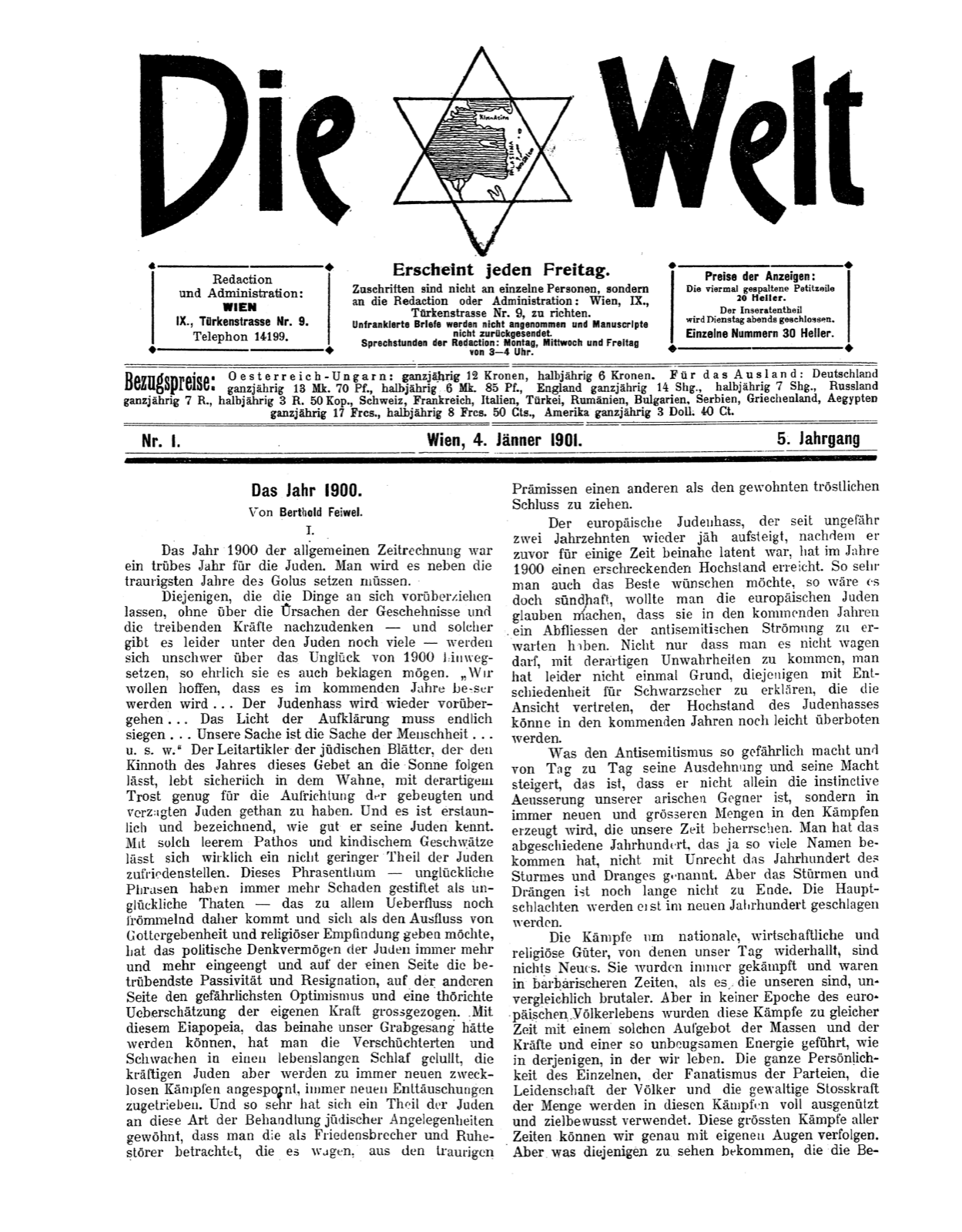
Die Welt
Appears every Friday.
Editorial Office and Administration: VIENNA IX., Türkenstrasse Nr. 9. Telephone 14199.
Communications are to be addressed not to individual persons, but to the Editorial Office or the Administration: Vienna, IX., Türkenstrasse Nr. 9. Unstamped letters are not accepted, and manuscripts are not returned. Office hours of the Editorial Office: Monday, Wednesday and Friday, from 3–4 o'clock.
Rates for advertisements: the four-column petit line, 20 Heller. The advertisement section closes Tuesday evening. Single numbers 30 Heller.
Subscription rates: Austria-Hungary: 12 Kronen yearly, 6 Kronen half-yearly. For abroad: Germany 13 Mk. 70 Pf. yearly, 6 Mk. 85 Pf. half-yearly; England 14 Shg. yearly, 7 Shg. half-yearly; Russia 7 R. yearly, 3 R. 50 Kop. half-yearly; Switzerland, France, Italy, Turkey, Roumania, Bulgaria, Servia, Greece, Egypt 17 Frcs. yearly, 8 Frcs. 50 Cts. half-yearly; America 3 Doll. 40 Ct. yearly.
No. 1. Vienna, 4 January 1901. Fifth Year
The Year 1900.
By Berthold Feiwel.
I.
The year 1900 of the common reckoning was a gloomy year for the Jews. It will have to be set beside the saddest years of the Golus.
Those who let things pass by them without reflecting upon the causes of events and upon the driving forces behind them — and of such there are unhappily still many among the Jews — will find it no hard matter to set themselves above the misfortune of 1900, however honestly they may deplore it. "Let us hope that in the coming year it will be better . . . The hatred of the Jews will pass away again . . . The light of enlightenment must conquer at last . . . Our cause is the cause of humanity . . . etc." The leading-article writer of the Jewish papers, who lets this prayer to the sun follow upon the Kinnoth of the year, assuredly lives in the delusion that with such consolation he has done enough for the raising up of the bowed and despondent Jews. And it is astonishing and characteristic how well he knows his Jews. With such empty pathos and childish chatter no small part of the Jews really allows itself to be satisfied. This phrase-mongering — unhappy phrases have always wrought more mischief than unhappy deeds — which to crown all comes forward in a sanctimonious guise and would fain give itself out as the effusion of resignation to God and of religious feeling, has narrowed the political faculty of thought of the Jews more and more, and has reared upon the one side the most distressing passivity and resignation, upon the other the most dangerous optimism and a foolish over-estimation of their own strength. With this Eiapopeia, which might well-nigh have become our dirge, the intimidated and the weak have been lulled into a lifelong sleep, while the vigorous Jews are spurred on to ever new and purposeless struggles, driven towards ever new disappointments. And a part of the Jews has grown so accustomed to this manner of treating Jewish affairs, that those are regarded as breakers of the peace and disturbers of the quiet who venture to draw from the sad premises any other than the accustomed comforting conclusion.
European Jew-hatred, which for some two decades past has again been rising abruptly, after having before that been for a time almost latent, reached in the year 1900 a terrifying high-water mark. However much one might wish the best, it would nevertheless be sinful to make the European Jews believe that in the coming years they have an ebbing of the anti-Semitic current to expect. Not only may one not venture to come forward with untruths of that kind; one has unhappily not even ground for declaring with decision those to be men of gloomy vision who maintain the view that the high-water mark of Jew-hatred may yet easily be surpassed in the years to come.
What makes anti-Semitism so dangerous, and from day to day increases its extension and its power, is that it is not merely the instinctive expression of our Aryan opponents, but is generated in ever new and greater quantities in the struggles which dominate our time. The departed century, which has received so many names, has not unjustly been called the century of storm and stress. But the storming and the stressing are far indeed from being at an end. The chief battles will not be fought until the new century.
The struggles for national, economic and religious goods, with which our day resounds, are nothing new. They have always been fought, and in ages more barbarous than ours they were incomparably more brutal. But in no epoch of the life of the European peoples were these struggles carried on at one and the same time with such a levying of the masses and of the forces, and with so unbending an energy, as in that in which we live. The whole personality of the individual, the fanaticism of parties, the passion of peoples and the mighty impact of the multitude are in these struggles fully turned to account and employed with conscious purpose. These greatest struggles of all time we can follow exactly with our own eyes. But what those get to see who the Be-