The Antisemitic Catechism (1893)
Page 41 • Click to zoom
Page 41 of 436
Seneca.
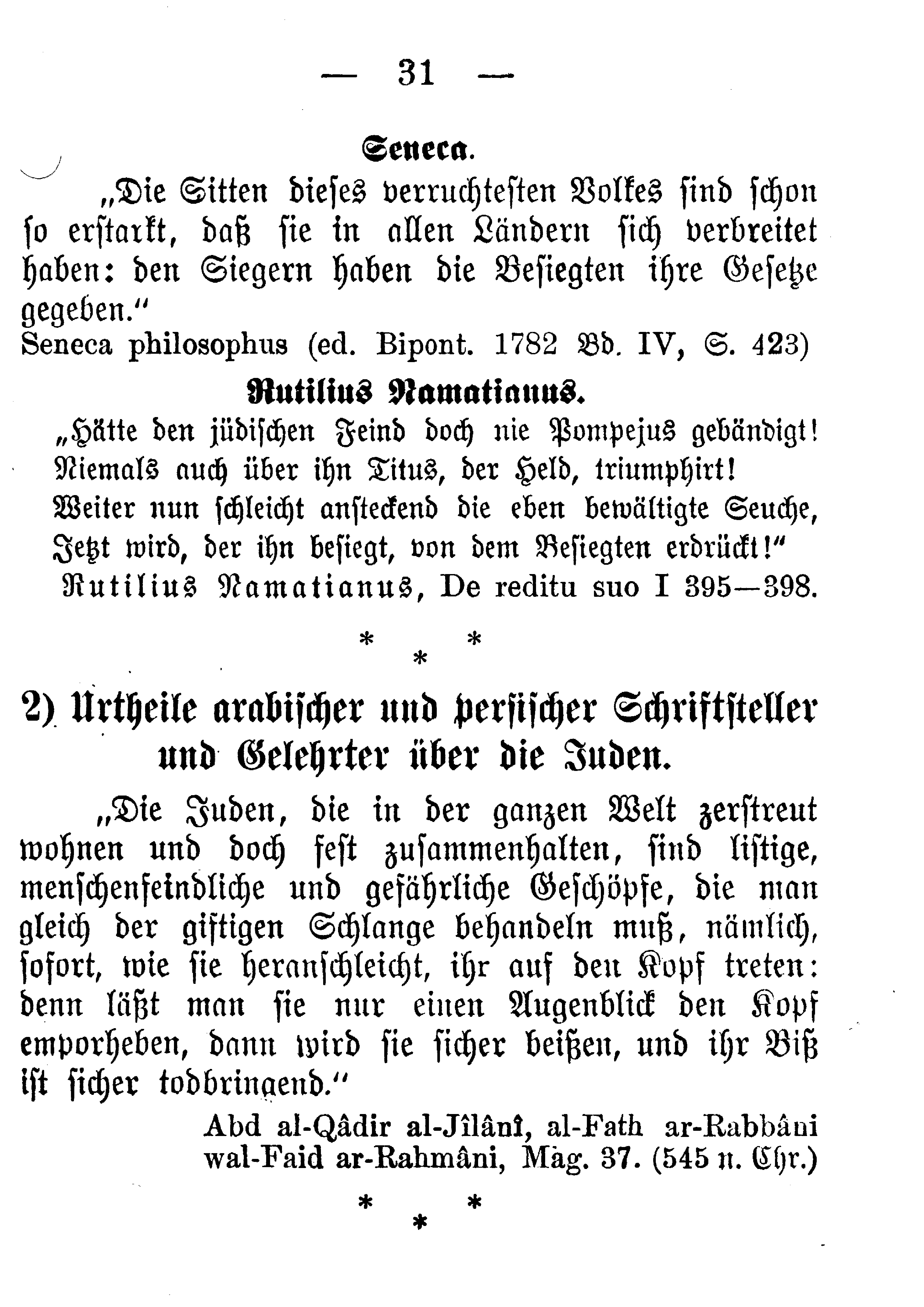
“The customs of this most wicked people have already grown so strong that they have spread into all lands: the vanquished have given their laws to the victors.” Seneca philosophus (ed. Bipont. 1782 Vol. IV, p. 423)
Rutilius Namatianus.
“If only Pompey had never subdued the Jewish foe! Nor the hero Titus ever triumphed over him! Now spreading further its evil contagion, the just-conquered plague, Now he who conquers him is crushed by the vanquished!” Rutilius Namatianus, De reditu suo I 395—398.
2) Judgments of Arab and Persian writers and scholars on the Jews.
“The Jews, who live scattered throughout the whole world and yet hold firmly together, are cunning, misanthropic, and dangerous creatures, who must be treated like the venomous snake, namely, to step on its head as soon as it creeps up: for if one lets it raise its head for even a moment, then it will surely bite, and its bite is surely fatal.” Abd al-Qâdir al-Jîlânî, al-Fath ar-Rabbânî wal-Faid ar-Rahmânî, Mag. 37. (545 A.D.)
Show Original German Text
— 31 — Seneca. „Die Sitten dieſes verruchtesten Volkes find schon ſo erstarkt, daß ſie in allen Ländem ſich verbreitet haben: den Siegem haben die Beſiegten ihre Geſetze gegeben.“ Seneca philofophus (ed. Bipont. 1782 Bd. IV, S. 423) Rutilius Namatianus. „Hätte den jüdischen Feind doch nie Pompejus gebändigt! Niemals auch über ihn Titus, der Held, tnumphirt! Weiter nun schlecht ansteckend die eben bewältigte Seuche, Jeßt wird, der ihn beſiegt, von dem Beſiegten erdrückt!“ Rutilius Namatianus, De reditu ſuo I 395—398. * * * * 2) Urtheile arabischer und perſischer Schnftsteller und Gelehrter über die Juden. „Die Juden, die in der ganzen Welt zerstreut wohnen und doch fest zuſammenhalten, ſind listige, menschenfeindliche und gefährliche Geschöpfe, die man gleich der giftigen Schlange behandeln muß, nämlich, ſofort, wie ſie heranschleicht, ihr auf den Kopf treten: denn läßt man ſie nur einen Augenblick den Kopf emporheben, dann wird ſie ſicher beißen, und ihr Biß ist ſicher todbnngend.“ Abd al-Qâdir al-Jîlânî, al-Fath ar-Rabbânî wal-Faid ar-Rahmânî, Mag. 37. (545 n. Chr.) * * * *